03.06.2026
Time to read:
9
min
Stages of Mobile Banking App Development
Development
Guides
Today, it is hard to imagine everyday life without a banking app. We transfer money to friends, pay for services, track our spending — and do it all from a smartphone in just a couple of taps. Even getting a new card no longer requires a trip anywhere: a virtual card can now be issued in just five minutes directly in the app.
Today, 91% of customers choose a bank based on the convenience of its mobile banking experience — in many ways, the app has become a full replacement for a physical branch. In this environment, banking app development requires a clear understanding of which services and features real users need and how to implement them effectively.
This shift means one thing: for a bank, having a convenient and secure mobile app is no longer a competitive advantage — it is a basic requirement. More than that, a well-designed app helps not only retain existing customers but also attract new ones.
So what goes into developing a banking app? What stages does it go through from idea to release? And how do you build a service users will trust with their money — one with an intuitive interface, stable performance, and strong security? Let’s break it down step by step.
Why Banks Are Moving to Smartphones: The Mobile Banking Market in 2026
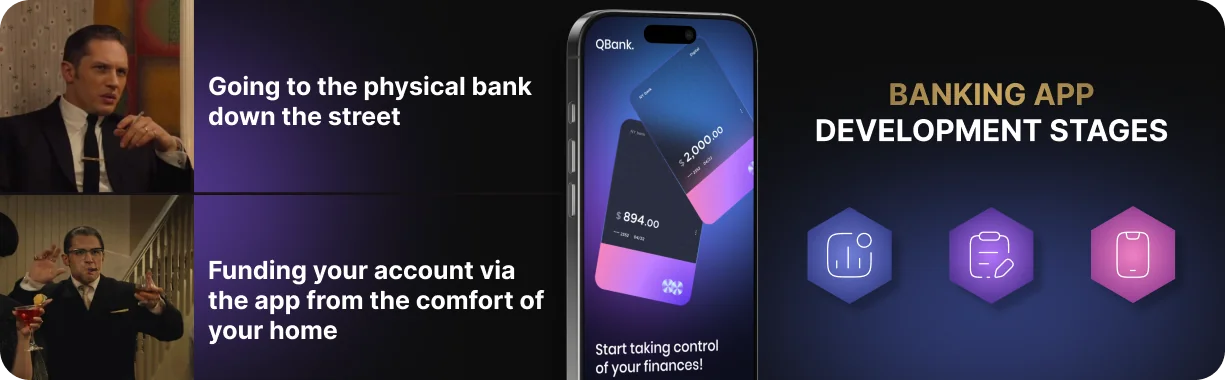
Users are rapidly shifting to digital channels, and for many of them, the mobile app has become the primary way to access banking services. Traditional branches are moving into the background: in the CIS, 89% of customers already use banking services through their smartphones, and in Europe this figure is rising quickly. Banks that fail to adapt their services to mobile lose customers — according to estimates, up to 76% of users are willing to switch banks for a more convenient app. In other words, without mobile development, it is difficult for a bank to retain customers and stay competitive.
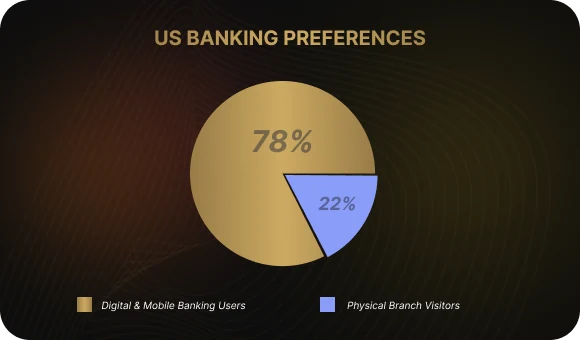
The market is becoming increasingly competitive, and the battle is no longer just between traditional banks — fintech companies built around mobile-first experiences are moving to the forefront.
Different Customers, Different Scenarios
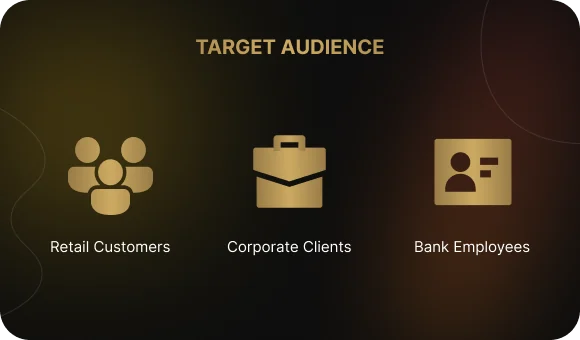
A mobile banking app needs to address the needs of several audiences at once. Here are the three main groups:
Retail customers: from students to retirees
For most people, a smartphone is now their main financial tool. They use the app to check balances, transfer money, pay bills, manage cards, and access key banking services. The younger the customer, the higher the expectations for speed and convenience: up to 68% of millennials consider the mobile app their main channel for interacting with a bank.
Business clients: speed, control, automation
Small and medium-sized businesses need to control expenses, pay invoices, run payroll, and integrate with accounting systems. More and more banks are building dedicated business apps and platforms tailored to corporate needs.
Bank employees: internal tools matter too
Mobile interfaces are also created for internal use — for example, to consult clients outside the office, approve applications, or work with analytics. These solutions are invisible to external users, but they directly affect the bank’s efficiency and service quality. Their development requires just as much attention as customer-facing interfaces.
That is why banking app development has become a priority for companies that want to retain customers and meet the expectations of the digital generation.
Who Is Already Doing It Well: Competitor Benchmarks
There are already strong players in the market, and their experience is worth studying:
T-Bank (Tinkoff). The first bank in Russia to build a branchless model. It has more than 34 million users and a powerful platform that combines financial services, cashback, investments, and an AI assistant.
SberBank Online. An impressive audience of more than 85 million monthly active users. The app has become the center of an ecosystem that covers everything from transfers to a marketplace, while its built-in AI assistant helps solve user requests without calls or queues.
Revolut. A European neobank focused on multicurrency support, security, and personalized financial services. Easy account opening, instant transfers, and flexible controls are all delivered within one mobile platform. By 2025, the app had surpassed 60 million users.
Monzo. A UK-based bank known for transparency and a friendly interface. The app includes budgeting tools, joint accounts, and in-app chat support. More than a third of its customers use it as their primary bank.
What Matters to Banking App Users
Regardless of the country, customer expectations are very similar. Here are three key needs that must be considered during development:
Simplicity and accessibility. The app needs to work fast and show only the services and functions users actually need. A couple of taps and the money is transferred — that has long become the standard in banking technology.
Security without unnecessary friction. Users want to feel confident that their data and money are protected, but they do not want to spend 30 seconds logging in every time. The best solutions already include biometrics, push alerts, instant card blocking, and AI-based fraud prevention.
A personal approach. Users expect banking platforms to offer recommendations and helpful prompts. Suggesting a deposit when savings have accumulated, reminding them to pay utilities, or showing spending analytics — these small details build trust and loyalty.
What a Banking App Should Be Able to Do
A modern banking app is not just a tool for transferring money. It is a full-fledged financial management platform with thoughtful logic and intuitive navigation. The better it serves the needs of different user groups, the stronger the trust in the bank.
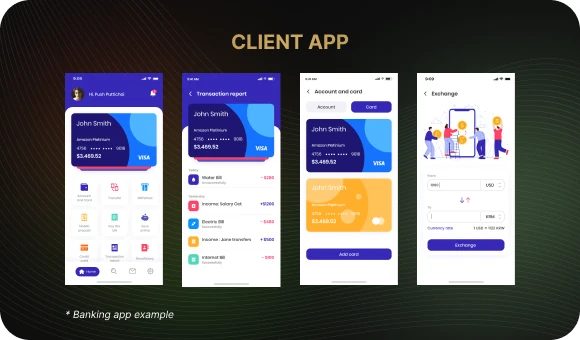
For retail customers: everything at their fingertips
It is important that the core scenarios — everything users do in the app every day — work quickly, require no unnecessary steps, and feel logical and intuitive.
Registration and login. The simpler, the better. At the same time, security must be strong: support for Face ID, fingerprint authentication, SMS codes, and other forms of two-factor authentication.
Accounts and cards. Users should be able to view balances, statements, and transaction details across all connected cards without extra navigation or confusing menus.
Payments and transfers. Sending money to a friend, paying rent, or covering utility bills should all be completed in just a few simple steps.
Loans and deposits. Users should be able to apply, check schedules, top up deposits, or repay loans early.
Investments. Access to stocks, bonds, funds, and basic analytics. The easier the entry point, the higher the engagement.
Financial assistant. Tools for expense tracking, budgeting, and money management tips.
Push notifications. Real-time alerts about logins, transactions, incoming funds, and personalized offers.
For business: control and automation
Business users have different needs. They need an app that lets them manage cash flow not only quickly, but also transparently, often together with a team.
Corporate accounts. Users should be able to quickly check balances, filter company transactions, and export statements.
Accounting integrations. The app connects to systems like 1C or QuickBooks to synchronize data and simplify bookkeeping.
Batch payments. Salaries, taxes, and other regular payments can be processed in batches, saving time and reducing the risk of errors.
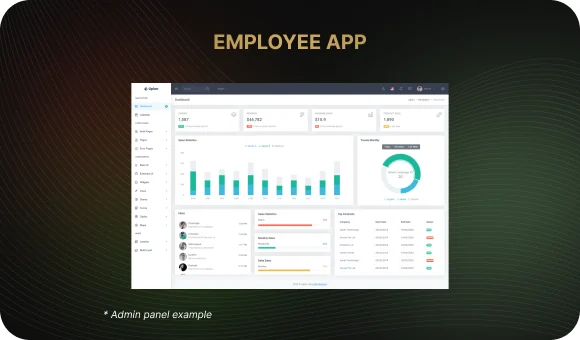
For bank employees: analytics and management
If the app is used inside the bank, it must be just as convenient and secure.
Activity monitoring. Employees can track real-time statistics and see what actions users are taking.
Access management. Admin panels make it easy to configure profiles, permissions, and role-based settings.
Analytics. Built-in analytics show how app features are used, where load is concentrated, and how actively users are engaging.
In other words, mobile banking app development must account for different usage scenarios — from retail customers to employees and business users.
How a Banking App Is Built: Step by Step
Building a banking app is not just a technical task. Behind a simple and intuitive service lies serious work — from requirements gathering to testing and ongoing support. To make sure the app runs smoothly and is convenient for users, the team goes through several key stages.
Step 1: Research and prototyping
Before starting mobile banking app development, the team needs to clearly understand why the app is being created and what matters most to users. Requirements are gathered from the bank, and the project goals are defined with the bank’s operating model, technical details, legal constraints, and business objectives in mind. At the same time, the team interviews customers and studies how they use banking services to identify which features are truly necessary.
Based on these findings, the team creates user stories — simple descriptions of each action available to the user inside the app. Then prototypes are developed: draft screen layouts that help visualize how the app will work. All of this is needed to make sure the platform solves real user problems and meets the bank’s requirements. Already at this stage, the foundation is laid for the rest of the project.
Step 2: Design
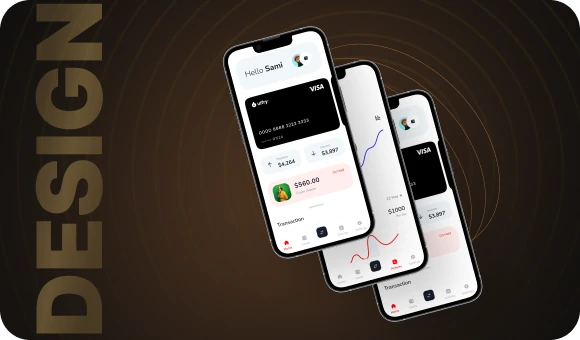
Once the app structure has been defined, the team moves on to the interface and interaction logic. All functions must be arranged logically, actions should require no unnecessary steps, and user data must remain protected. The design is adapted for different device types and takes accessibility requirements into account.
The purpose of design is not just to make the app visually appealing, but to think through how users will interact with it comfortably. It is important to understand in advance which steps they take, where they may get confused, and how to help them move through the experience without delays or frustration. All of these details are addressed before full-scale development begins.
Step 3: Development
Once the design is approved, technical implementation begins. Developers write the code and launch the core functions: transfers, account operations, and data protection. At the same time, the app is integrated with the bank’s internal systems and external services — for example, those used for document verification or loan calculations.
Project delivery is a coordinated process involving a multidisciplinary team. Frontend developers are responsible for building an intuitive, user-friendly interface. Backend engineers handle the internal logic and data management. DevOps engineers ensure the stability and performance of the infrastructure, while the QA team makes sure every part of the system works flawlessly. Only close coordination across all these areas makes it possible to build a reliable, unified product.
Step 4: Testing
Before launch, the app must be thoroughly tested. Specialists check whether registration works, whether transfers go through, and whether balances are displayed correctly for each card. Special attention is paid to security — it is essential to ensure that user data is protected and attackers cannot compromise the system.
In addition, resilience testing is performed. The app is stressed as if thousands of people were using it simultaneously, simulating typical banking traffic, to see how it behaves under load. If any failures or delays appear, the development team fixes them. All of this ensures that by launch, the app is already stable and dependable.
Step 5: Launch and support
Once the app is ready and has passed all testing stages, it is published in the App Store and Google Play. But the work does not stop there — the next critical phase begins.
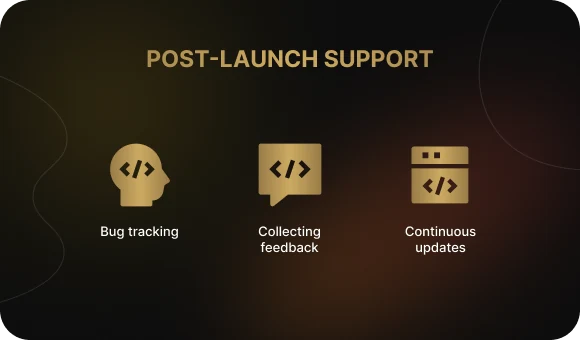
The team monitors how the app performs in real use: gathering feedback, tracking crashes and errors, and analyzing user behavior inside the service. Based on this information, updates are released. Some features are improved, some flows are simplified, and new services are added based on what customers want most. A good app does not stay static — it evolves together with audience expectations and the changing market.
Data Protection as a Priority
Reliability and security are the foundation of any banking app. Users need to be confident that their data will not fall into the wrong hands and that access to their accounts and money is properly protected. This means not only strong data protection, but also early risk detection technologies: anti-fraud systems, encryption, and biometrics.
From the very beginning, all necessary safeguards are built into the mobile banking project: encryption such as AES-256, secure transmission channels, and two-factor authentication. The app must also undergo compliance checks against standards such as GDPR, PCI DSS, and central bank requirements.
Alongside these technical measures, monitoring systems are introduced to detect suspicious activity in time and block fraud attempts. Regular security audits confirm that the product is stable and ready for heavy usage.
Legal Foundations Under Control
A banking app cannot go live without meeting all formal legal requirements. This is especially important for products that handle financial transactions and customer data. During the preparation stage, the team takes central bank regulations, local laws, and international requirements into account.
At the same time, user agreements and privacy policies are prepared. It is also important to address licensing issues in advance, especially for products working with payment systems. This builds trust and minimizes legal risks for the bank.
How to Choose a Team for Banking App Development
Building a strong banking app requires a development team that understands fintech and knows how to balance security, usability, and speed. Everything matters — from interface design to integration with banking systems and support for the key services offered inside the app.
A well-executed banking app can become a real breakthrough in the industry: it can take your product to the next level, strengthen customer loyalty, and even set a new market standard.
The Beetrail team handles the entire process — from idea to launch. Our specialization is mobile app development for banks and financial companies, and we support the project at every stage: analytics, planning, development, testing, release, and post-launch growth.
We use proven technologies, choose solutions based on the product’s goals and scale, and know how to build a product people will trust.
Want to discuss your project? Message us, and together we will define the stages, tasks, and development format, and select the right solution for your goals and budget.
Why Banks Are Moving to Smartphones: The Mobile Banking Market in 2026
Users are rapidly shifting to digital channels, and for many of them, the mobile app has become the primary way to access banking services. Traditional branches are moving into the background: in the CIS, 89% of customers already use banking services through their smartphones, and in Europe this figure is rising quickly. Banks that fail to adapt their services to mobile lose customers — according to estimates, up to 76% of users are willing to switch banks for a more convenient app. In other words, without mobile development, it is difficult for a bank to retain customers and stay competitive.
The market is becoming increasingly competitive, and the battle is no longer just between traditional banks — fintech companies built around mobile-first experiences are moving to the forefront.
Different Customers, Different Scenarios
A mobile banking app needs to address the needs of several audiences at once. Here are the three main groups:
Retail customers: from students to retirees
For most people, a smartphone is now their main financial tool. They use the app to check balances, transfer money, pay bills, manage cards, and access key banking services. The younger the customer, the higher the expectations for speed and convenience: up to 68% of millennials consider the mobile app their main channel for interacting with a bank.
Business clients: speed, control, automation
Small and medium-sized businesses need to control expenses, pay invoices, run payroll, and integrate with accounting systems. More and more banks are building dedicated business apps and platforms tailored to corporate needs.
Bank employees: internal tools matter too
Mobile interfaces are also created for internal use — for example, to consult clients outside the office, approve applications, or work with analytics. These solutions are invisible to external users, but they directly affect the bank’s efficiency and service quality. Their development requires just as much attention as customer-facing interfaces.
That is why banking app development has become a priority for companies that want to retain customers and meet the expectations of the digital generation.
Who Is Already Doing It Well: Competitor Benchmarks
There are already strong players in the market, and their experience is worth studying:
T-Bank (Tinkoff). The first bank in Russia to build a branchless model. It has more than 34 million users and a powerful platform that combines financial services, cashback, investments, and an AI assistant.
SberBank Online. An impressive audience of more than 85 million monthly active users. The app has become the center of an ecosystem that covers everything from transfers to a marketplace, while its built-in AI assistant helps solve user requests without calls or queues.
Revolut. A European neobank focused on multicurrency support, security, and personalized financial services. Easy account opening, instant transfers, and flexible controls are all delivered within one mobile platform. By 2025, the app had surpassed 60 million users.
Monzo. A UK-based bank known for transparency and a friendly interface. The app includes budgeting tools, joint accounts, and in-app chat support. More than a third of its customers use it as their primary bank.
What Matters to Banking App Users
Regardless of the country, customer expectations are very similar. Here are three key needs that must be considered during development:
Simplicity and accessibility. The app needs to work fast and show only the services and functions users actually need. A couple of taps and the money is transferred — that has long become the standard in banking technology.
Security without unnecessary friction. Users want to feel confident that their data and money are protected, but they do not want to spend 30 seconds logging in every time. The best solutions already include biometrics, push alerts, instant card blocking, and AI-based fraud prevention.
A personal approach. Users expect banking platforms to offer recommendations and helpful prompts. Suggesting a deposit when savings have accumulated, reminding them to pay utilities, or showing spending analytics — these small details build trust and loyalty.
What a Banking App Should Be Able to Do
A modern banking app is not just a tool for transferring money. It is a full-fledged financial management platform with thoughtful logic and intuitive navigation. The better it serves the needs of different user groups, the stronger the trust in the bank.
For retail customers: everything at their fingertips
It is important that the core scenarios — everything users do in the app every day — work quickly, require no unnecessary steps, and feel logical and intuitive.
Registration and login. The simpler, the better. At the same time, security must be strong: support for Face ID, fingerprint authentication, SMS codes, and other forms of two-factor authentication.
Accounts and cards. Users should be able to view balances, statements, and transaction details across all connected cards without extra navigation or confusing menus.
Payments and transfers. Sending money to a friend, paying rent, or covering utility bills should all be completed in just a few simple steps.
Loans and deposits. Users should be able to apply, check schedules, top up deposits, or repay loans early.
Investments. Access to stocks, bonds, funds, and basic analytics. The easier the entry point, the higher the engagement.
Financial assistant. Tools for expense tracking, budgeting, and money management tips.
Push notifications. Real-time alerts about logins, transactions, incoming funds, and personalized offers.
For business: control and automation
Business users have different needs. They need an app that lets them manage cash flow not only quickly, but also transparently, often together with a team.
Corporate accounts. Users should be able to quickly check balances, filter company transactions, and export statements.
Accounting integrations. The app connects to systems like 1C or QuickBooks to synchronize data and simplify bookkeeping.
Batch payments. Salaries, taxes, and other regular payments can be processed in batches, saving time and reducing the risk of errors.
For bank employees: analytics and management
If the app is used inside the bank, it must be just as convenient and secure.
Activity monitoring. Employees can track real-time statistics and see what actions users are taking.
Access management. Admin panels make it easy to configure profiles, permissions, and role-based settings.
Analytics. Built-in analytics show how app features are used, where load is concentrated, and how actively users are engaging.
In other words, mobile banking app development must account for different usage scenarios — from retail customers to employees and business users.
How a Banking App Is Built: Step by Step
Building a banking app is not just a technical task. Behind a simple and intuitive service lies serious work — from requirements gathering to testing and ongoing support. To make sure the app runs smoothly and is convenient for users, the team goes through several key stages.
Step 1: Research and prototyping
Before starting mobile banking app development, the team needs to clearly understand why the app is being created and what matters most to users. Requirements are gathered from the bank, and the project goals are defined with the bank’s operating model, technical details, legal constraints, and business objectives in mind. At the same time, the team interviews customers and studies how they use banking services to identify which features are truly necessary.
Based on these findings, the team creates user stories — simple descriptions of each action available to the user inside the app. Then prototypes are developed: draft screen layouts that help visualize how the app will work. All of this is needed to make sure the platform solves real user problems and meets the bank’s requirements. Already at this stage, the foundation is laid for the rest of the project.
Step 2: Design
Once the app structure has been defined, the team moves on to the interface and interaction logic. All functions must be arranged logically, actions should require no unnecessary steps, and user data must remain protected. The design is adapted for different device types and takes accessibility requirements into account.
The purpose of design is not just to make the app visually appealing, but to think through how users will interact with it comfortably. It is important to understand in advance which steps they take, where they may get confused, and how to help them move through the experience without delays or frustration. All of these details are addressed before full-scale development begins.
Step 3: Development
Once the design is approved, technical implementation begins. Developers write the code and launch the core functions: transfers, account operations, and data protection. At the same time, the app is integrated with the bank’s internal systems and external services — for example, those used for document verification or loan calculations.
Project delivery is a coordinated process involving a multidisciplinary team. Frontend developers are responsible for building an intuitive, user-friendly interface. Backend engineers handle the internal logic and data management. DevOps engineers ensure the stability and performance of the infrastructure, while the QA team makes sure every part of the system works flawlessly. Only close coordination across all these areas makes it possible to build a reliable, unified product.
Step 4: Testing
Before launch, the app must be thoroughly tested. Specialists check whether registration works, whether transfers go through, and whether balances are displayed correctly for each card. Special attention is paid to security — it is essential to ensure that user data is protected and attackers cannot compromise the system.
In addition, resilience testing is performed. The app is stressed as if thousands of people were using it simultaneously, simulating typical banking traffic, to see how it behaves under load. If any failures or delays appear, the development team fixes them. All of this ensures that by launch, the app is already stable and dependable.
Step 5: Launch and support
Once the app is ready and has passed all testing stages, it is published in the App Store and Google Play. But the work does not stop there — the next critical phase begins.
The team monitors how the app performs in real use: gathering feedback, tracking crashes and errors, and analyzing user behavior inside the service. Based on this information, updates are released. Some features are improved, some flows are simplified, and new services are added based on what customers want most. A good app does not stay static — it evolves together with audience expectations and the changing market.
Data Protection as a Priority
Reliability and security are the foundation of any banking app. Users need to be confident that their data will not fall into the wrong hands and that access to their accounts and money is properly protected. This means not only strong data protection, but also early risk detection technologies: anti-fraud systems, encryption, and biometrics.
From the very beginning, all necessary safeguards are built into the mobile banking project: encryption such as AES-256, secure transmission channels, and two-factor authentication. The app must also undergo compliance checks against standards such as GDPR, PCI DSS, and central bank requirements.
Alongside these technical measures, monitoring systems are introduced to detect suspicious activity in time and block fraud attempts. Regular security audits confirm that the product is stable and ready for heavy usage.
Legal Foundations Under Control
A banking app cannot go live without meeting all formal legal requirements. This is especially important for products that handle financial transactions and customer data. During the preparation stage, the team takes central bank regulations, local laws, and international requirements into account.
At the same time, user agreements and privacy policies are prepared. It is also important to address licensing issues in advance, especially for products working with payment systems. This builds trust and minimizes legal risks for the bank.
How to Choose a Team for Banking App Development
Building a strong banking app requires a development team that understands fintech and knows how to balance security, usability, and speed. Everything matters — from interface design to integration with banking systems and support for the key services offered inside the app.
A well-executed banking app can become a real breakthrough in the industry: it can take your product to the next level, strengthen customer loyalty, and even set a new market standard.
The Beetrail team handles the entire process — from idea to launch. Our specialization is mobile app development for banks and financial companies, and we support the project at every stage: analytics, planning, development, testing, release, and post-launch growth.
We use proven technologies, choose solutions based on the product’s goals and scale, and know how to build a product people will trust.
Want to discuss your project? Message us, and together we will define the stages, tasks, and development format, and select the right solution for your goals and budget.