07.06.2026
Time to read:
7
min
How to create a dating app
Development
Guides
The online dating market is experiencing a real boom. According to estimates from BreakTheCycle, the global audience of dating app users reached about 381 million people in 2024, with a forecast of 452 million by 2028.
People are looking for communication, love, and simply good company — and now all of this happens through apps. It is no surprise that more and more companies are thinking about how to create a dating app and take their niche in this market.
Think of Tinder, Bumble, and Badoo — each of them has its own target audience, style, and unique features. These projects have proven that if a developer offers a convenient and well-designed mobile service, it can become global. But how do you approach development the right way? Let’s break it down step by step.
Market and Target Audience Analysis
Before creating a service, it is important to understand who you are building it for. Research your competitors — what features and services they offer, how their interface is structured, and which marketing strategies they use.
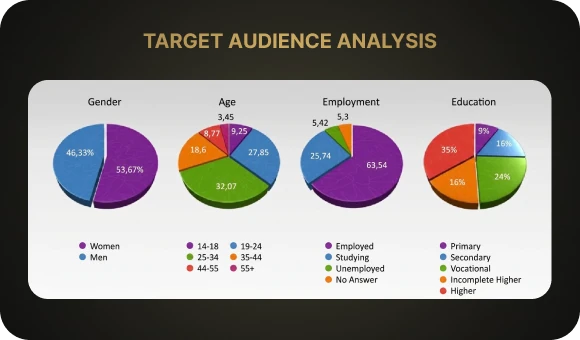
Next, define your audience. Age, interests, and communication style will all affect the design and functionality. For example, the 18–25 age group tends to prefer fast swiping and video chats, while users aged 35+ often value detailed profiles and advanced filters.
To stand out, you need to think through your unique selling proposition. Maybe your app will be for single parents, book lovers, or people who have moved to a new country. A narrow niche is not a disadvantage — it is a way to build a loyal audience.
What Features a Dating App Needs
Core features you cannot do without:
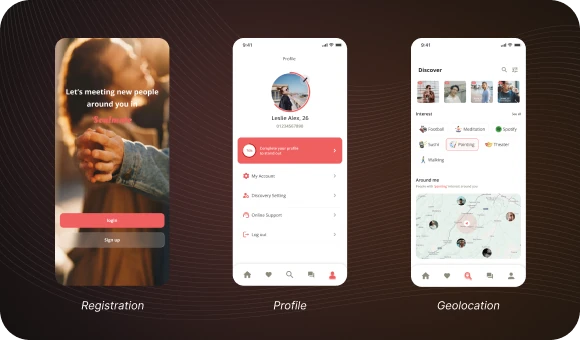
Registration is the first step in interacting with the app. It is best to offer several sign-up methods: via email, phone number, and popular social networks such as VK, Google, or Apple ID. This allows the user to choose the most familiar login method and increases trust in the service. In addition, social networks often provide access to basic information such as name, age, and photos, which simplifies profile creation and speeds up onboarding.
Profile creation and editing is an important stage that directly affects the quality of user interaction. The more detailed and visual the profile, the higher the chance of a successful match. The profile should include fields for uploading photos, listing interests, writing a short bio, indicating partner preferences, and possibly even adding a voice greeting. The more information a user can provide, the easier it is for algorithms to suggest suitable matches. It is also important to make profiles editable at any time and ensure simple navigation within this section. A good practice is content validation — for example, automatic photo cropping, image quality suggestions, and character limits in descriptions.
Geolocation is one of the key functions in dating apps. It helps display nearby users, increasing the chances of meeting quickly. Geolocation can take into account not only the user’s current location, but also allow them to set a search radius, filter profiles by distance, and see who has recently been nearby. It is important to configure permission requests properly and explain why the app needs this access — this increases trust. For additional convenience, you can offer an invisible mode or the ability to choose a virtual location; such features are appreciated for privacy and flexibility.
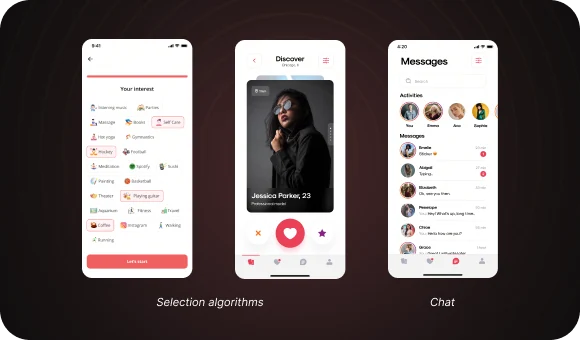
Matching algorithms are the heart of any dating app. Their accuracy and logic determine how relevant the suggested matches will be. The basic option is the swipe system familiar to many from Tinder: swiping profiles left or right. However, that alone is not enough. It is important to build a dating app with smart filters from the start: by interests, age, distance, relationship status, dating goals, and other parameters. Services increasingly use machine learning: algorithms analyze user behavior, track which profiles they like, which photos they click on more often, and build a personalized feed. This increases engagement and conversion into real conversations. The more precise and nuanced the matching works, the higher the chance that the user will stay in the app.
Chat for communication is a полноценный tool for establishing contact between users. It must be intuitive, fast, and safe. It is important to implement spam protection, profanity filters, and the ability to report inappropriate messages. Users expect chat to support sending photos, audio, emojis, and possibly even voice and video messages. Useful features also include deleting messages, seeing read status, and a typing indicator. All of this makes communication feel more natural and much closer to real-life interaction.
Additionally, it is worth implementing:
- Video chats — especially relevant after the pandemic, when many people got used to communicating online. This makes it easier for users to establish visual contact before meeting and build trust.
- A system of gifts and likes for gamification — this adds an element of play to communication. Chat partners can send virtual stickers, gifts, or expressions of sympathy, which makes interaction more emotional and engaging.
- Safety tools: automatic and manual photo verification, a reporting system for inappropriate content, blocking violators, and profile verification. This helps create a safe and comfortable space for communication.
- Monetization mechanisms: premium subscriptions with access to advanced services, in-app currency for purchases such as boosts or gifts, as well as advertising integrated in a way that does not interfere with the user experience.
How to Choose a Monetization Model
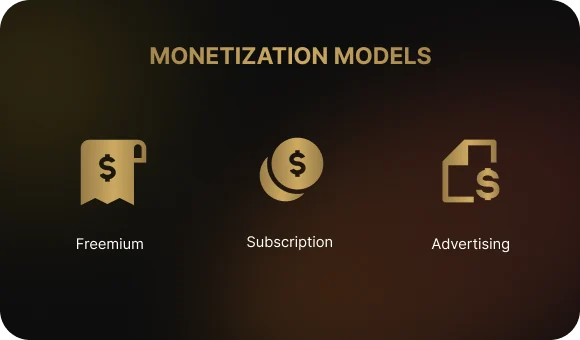
There are three popular options:
- Freemium — the core of the app is free, while users pay for individual features.
- Subscription — access to all features and services for a monthly fee.
- Advertising — showing ads in exchange for free access.
Sometimes all three models are combined, but it is important to understand which one fits your audience and product. Freemium works well for attracting a mass audience and monetizing them gradually. Subscriptions are effective for services with a strong base of loyal users willing to pay for convenience and exclusivity. Advertising is suitable for free solutions with a wide user base, especially if users are not ready to pay.
Stages of Mobile App Development
To answer the question of how to create a dating app, the process can be divided into 7 stages:
Analysis and planning — the foundation of the future app. Here, we clarify business goals, the needs of the target audience, and market specifics. At this stage, we create the technical specification that will serve as the roadmap for the whole development process. We also gather ideas, define key features, priorities, and constraints. All of this helps developers avoid unnecessary costs later, see a clear project structure, and move toward launch without chaos. For the client, this is a chance to see how the idea takes shape and logic.
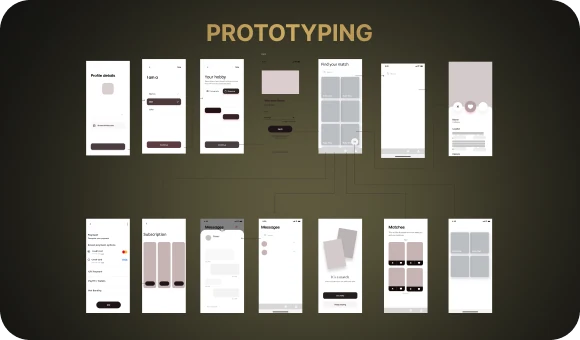
Prototyping — the moment when ideas turn into visual scenarios. We build user journeys: how a person will register, browse profiles, and communicate. Then we create a clickable prototype — almost like a real app, just without code. This makes it possible to see and feel the interface in advance, test convenience, and fix weak points on time. For business, this is a clear way to make sure the future service meets audience expectations before development starts and money is invested in programming.
Design is about convenience and interaction logic. At this stage, we build the user experience (UX) so that every screen is clear and the path to the goal is short. UI design includes colors, fonts, buttons, and animations that shape the first impression. For business, this means: the easier the app is to use, the higher the engagement and conversion into actions such as registration, chatting, or subscription. A good interface creates a sense of trust from the very first seconds.
Programming is the stage where ideas receive technical implementation. We choose the right platform: iOS, Android, or a universal cross-platform solution such as Flutter. The choice depends on the target audience, budget, and launch timeline. Developers build the “skeleton” of the app, connect screens, and set up the logic for algorithms, chats, and geolocation. Everything must work stably, quickly, and securely. This stage may seem complex, but with a clear specification and an experienced team, creating a dating app becomes a matter of execution.
Testing is where the idea turns into a reliable digital product. We check how every feature works, track bugs, and evaluate convenience for the user. Scenarios are tested both manually and automatically to ensure the app does not freeze, works correctly on different devices, and does what users expect. For business, this is a guarantee that the launch will go smoothly without reputational risks or dissatisfaction from the first users.
Publishing. At this stage, we prepare the product page: select screenshots, write a concise and engaging description, and choose keywords for search. Proper presentation affects first impressions, click-through rate, and installations. We also ensure compliance with the requirements of the App Store and Google Play so that moderation is passed on the first try. This stage is important for a successful launch and visibility among competitors.
Support and growth are the key to the app’s long-term success. After release, it is important not to stop: analyze user behavior, collect feedback, and improve features. Adding new capabilities, testing hypotheses, and running A/B tests help maintain interest. At the same time, a growth strategy is built: advertising is launched, marketing is strengthened, and partnerships are connected. All this ensures a stable flow of new users and increases engagement.
Examples of Successful Apps
Tinder has become a symbol of fast online dating. Its main feature is the swipe mechanic: swipe right to like, swipe left to skip. This is a simple and engaging way to choose potential partners. The matching algorithms take into account geolocation, age, activity, and even past preferences.
Users get a feed where every next profile feels like intrigue. The simplicity of the interface and the anonymity of the first steps attracted a young audience all over the world. Today, Tinder offers subscriptions, boosts, and advanced filters for monetization and retention.
Badoo, unlike Tinder, is aimed at a broader audience and focuses on a wider variety of features. Here, users can search for people not only through swiping, but also by interests, city, likes, and even by who has been nearby. Profiles contain more information, which appeals to those looking for more serious relationships.
The platform actively develops safety features: photo checks, selfie verification, and a moderation system. Badoo also offers paid features, gifts, invisible mode, and subscriptions.
Both projects show that success is in the details. It is not enough to simply develop a user interface — you need to give people comfort and trust.
Conclusion: Time to Act
Now you know how to create a dating app, what is important to consider at each stage, and how to turn an idea into a working product. Success comes not only from a good concept, but also from attention to user needs, quality, and stable service performance.
The Beetrail team creates dating apps from scratch. We think through the architecture, design, and logic — and guide your project from idea to publication.
Want to discuss dating app development? Get in touch — we will help you build a product that can grow.
Market and Target Audience Analysis
Before creating a service, it is important to understand who you are building it for. Research your competitors — what features and services they offer, how their interface is structured, and which marketing strategies they use.
Next, define your audience. Age, interests, and communication style will all affect the design and functionality. For example, the 18–25 age group tends to prefer fast swiping and video chats, while users aged 35+ often value detailed profiles and advanced filters.
To stand out, you need to think through your unique selling proposition. Maybe your app will be for single parents, book lovers, or people who have moved to a new country. A narrow niche is not a disadvantage — it is a way to build a loyal audience.
What Features a Dating App Needs
Core features you cannot do without:
Registration is the first step in interacting with the app. It is best to offer several sign-up methods: via email, phone number, and popular social networks such as VK, Google, or Apple ID. This allows the user to choose the most familiar login method and increases trust in the service. In addition, social networks often provide access to basic information such as name, age, and photos, which simplifies profile creation and speeds up onboarding.
Profile creation and editing is an important stage that directly affects the quality of user interaction. The more detailed and visual the profile, the higher the chance of a successful match. The profile should include fields for uploading photos, listing interests, writing a short bio, indicating partner preferences, and possibly even adding a voice greeting. The more information a user can provide, the easier it is for algorithms to suggest suitable matches. It is also important to make profiles editable at any time and ensure simple navigation within this section. A good practice is content validation — for example, automatic photo cropping, image quality suggestions, and character limits in descriptions.
Geolocation is one of the key functions in dating apps. It helps display nearby users, increasing the chances of meeting quickly. Geolocation can take into account not only the user’s current location, but also allow them to set a search radius, filter profiles by distance, and see who has recently been nearby. It is important to configure permission requests properly and explain why the app needs this access — this increases trust. For additional convenience, you can offer an invisible mode or the ability to choose a virtual location; such features are appreciated for privacy and flexibility.
Matching algorithms are the heart of any dating app. Their accuracy and logic determine how relevant the suggested matches will be. The basic option is the swipe system familiar to many from Tinder: swiping profiles left or right. However, that alone is not enough. It is important to build a dating app with smart filters from the start: by interests, age, distance, relationship status, dating goals, and other parameters. Services increasingly use machine learning: algorithms analyze user behavior, track which profiles they like, which photos they click on more often, and build a personalized feed. This increases engagement and conversion into real conversations. The more precise and nuanced the matching works, the higher the chance that the user will stay in the app.
Chat for communication is a полноценный tool for establishing contact between users. It must be intuitive, fast, and safe. It is important to implement spam protection, profanity filters, and the ability to report inappropriate messages. Users expect chat to support sending photos, audio, emojis, and possibly even voice and video messages. Useful features also include deleting messages, seeing read status, and a typing indicator. All of this makes communication feel more natural and much closer to real-life interaction.
Additionally, it is worth implementing:
- Video chats — especially relevant after the pandemic, when many people got used to communicating online. This makes it easier for users to establish visual contact before meeting and build trust.
- A system of gifts and likes for gamification — this adds an element of play to communication. Chat partners can send virtual stickers, gifts, or expressions of sympathy, which makes interaction more emotional and engaging.
- Safety tools: automatic and manual photo verification, a reporting system for inappropriate content, blocking violators, and profile verification. This helps create a safe and comfortable space for communication.
- Monetization mechanisms: premium subscriptions with access to advanced services, in-app currency for purchases such as boosts or gifts, as well as advertising integrated in a way that does not interfere with the user experience.
How to Choose a Monetization Model
There are three popular options:
- Freemium — the core of the app is free, while users pay for individual features.
- Subscription — access to all features and services for a monthly fee.
- Advertising — showing ads in exchange for free access.
Sometimes all three models are combined, but it is important to understand which one fits your audience and product. Freemium works well for attracting a mass audience and monetizing them gradually. Subscriptions are effective for services with a strong base of loyal users willing to pay for convenience and exclusivity. Advertising is suitable for free solutions with a wide user base, especially if users are not ready to pay.
Stages of Mobile App Development
To answer the question of how to create a dating app, the process can be divided into 7 stages:
Analysis and planning — the foundation of the future app. Here, we clarify business goals, the needs of the target audience, and market specifics. At this stage, we create the technical specification that will serve as the roadmap for the whole development process. We also gather ideas, define key features, priorities, and constraints. All of this helps developers avoid unnecessary costs later, see a clear project structure, and move toward launch without chaos. For the client, this is a chance to see how the idea takes shape and logic.
Prototyping — the moment when ideas turn into visual scenarios. We build user journeys: how a person will register, browse profiles, and communicate. Then we create a clickable prototype — almost like a real app, just without code. This makes it possible to see and feel the interface in advance, test convenience, and fix weak points on time. For business, this is a clear way to make sure the future service meets audience expectations before development starts and money is invested in programming.
Design is about convenience and interaction logic. At this stage, we build the user experience (UX) so that every screen is clear and the path to the goal is short. UI design includes colors, fonts, buttons, and animations that shape the first impression. For business, this means: the easier the app is to use, the higher the engagement and conversion into actions such as registration, chatting, or subscription. A good interface creates a sense of trust from the very first seconds.
Programming is the stage where ideas receive technical implementation. We choose the right platform: iOS, Android, or a universal cross-platform solution such as Flutter. The choice depends on the target audience, budget, and launch timeline. Developers build the “skeleton” of the app, connect screens, and set up the logic for algorithms, chats, and geolocation. Everything must work stably, quickly, and securely. This stage may seem complex, but with a clear specification and an experienced team, creating a dating app becomes a matter of execution.
Testing is where the idea turns into a reliable digital product. We check how every feature works, track bugs, and evaluate convenience for the user. Scenarios are tested both manually and automatically to ensure the app does not freeze, works correctly on different devices, and does what users expect. For business, this is a guarantee that the launch will go smoothly without reputational risks or dissatisfaction from the first users.
Publishing. At this stage, we prepare the product page: select screenshots, write a concise and engaging description, and choose keywords for search. Proper presentation affects first impressions, click-through rate, and installations. We also ensure compliance with the requirements of the App Store and Google Play so that moderation is passed on the first try. This stage is important for a successful launch and visibility among competitors.
Support and growth are the key to the app’s long-term success. After release, it is important not to stop: analyze user behavior, collect feedback, and improve features. Adding new capabilities, testing hypotheses, and running A/B tests help maintain interest. At the same time, a growth strategy is built: advertising is launched, marketing is strengthened, and partnerships are connected. All this ensures a stable flow of new users and increases engagement.
Examples of Successful Apps
Tinder has become a symbol of fast online dating. Its main feature is the swipe mechanic: swipe right to like, swipe left to skip. This is a simple and engaging way to choose potential partners. The matching algorithms take into account geolocation, age, activity, and even past preferences.
Users get a feed where every next profile feels like intrigue. The simplicity of the interface and the anonymity of the first steps attracted a young audience all over the world. Today, Tinder offers subscriptions, boosts, and advanced filters for monetization and retention.
Badoo, unlike Tinder, is aimed at a broader audience and focuses on a wider variety of features. Here, users can search for people not only through swiping, but also by interests, city, likes, and even by who has been nearby. Profiles contain more information, which appeals to those looking for more serious relationships.
The platform actively develops safety features: photo checks, selfie verification, and a moderation system. Badoo also offers paid features, gifts, invisible mode, and subscriptions.
Both projects show that success is in the details. It is not enough to simply develop a user interface — you need to give people comfort and trust.
Conclusion: Time to Act
Now you know how to create a dating app, what is important to consider at each stage, and how to turn an idea into a working product. Success comes not only from a good concept, but also from attention to user needs, quality, and stable service performance.
The Beetrail team creates dating apps from scratch. We think through the architecture, design, and logic — and guide your project from idea to publication.
Want to discuss dating app development? Get in touch — we will help you build a product that can grow.