03.06.2026
Time to read:
8
min
Programming Languages for Mobile Apps
Guides
Insights
When you start thinking about building a mobile app, the first technical question you face is which programming language mobile apps are built with. This choice affects not only the product’s performance and stability, but also the development timeline, maintenance costs, and future scalability.
Mobile development falls into two main areas: native development (for a specific platform such as iOS or Android) and cross-platform development (one codebase for both systems). Each approach requires its own programming languages and tools, and each comes with its own pros and cons.
In this article, we’ll look at which programming languages are used in mobile development today, how to choose the right one, and why it is important to consider not only the technology itself, but also your project goals, budget, and team capabilities.
Native Development: Languages for Platform Purity
Swift — Apple’s Language, Here to Stay
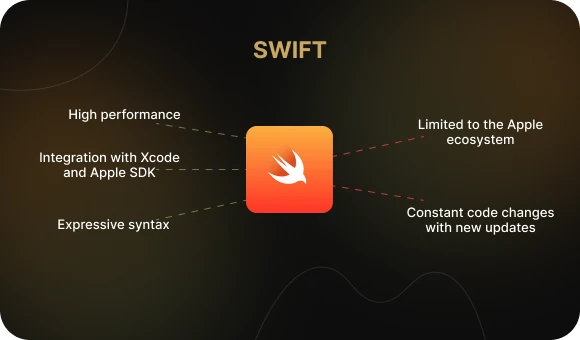
When talking about the main programming languages used in mobile app development, Swift stands out as Apple’s modern alternative to Objective-C. It quickly became the primary tool for iOS development. Swift combines powerful capabilities with concise syntax, making it convenient for developers at all levels.
Why Swift is chosen
- It compiles into fast machine code, delivering excellent performance.
- Integration with Xcode and the Apple SDK helps speed up development.
- Its functional-style syntax makes code easier to read and maintain.
Drawbacks
- It only supports the Apple ecosystem.
- Frequent language updates may require regular codebase changes.
Best suited for:
Companies building iOS apps with a focus on long-term support and deep platform integration, such as banking and fintech applications.
Kotlin — Modern Android Development with Cross-Platform Ambitions
Today, Kotlin is what Android mobile apps are primarily built with. It changed the way mobile applications are developed for Google’s platform. Since 2017, when Google officially announced Kotlin as the preferred language for Android development, it has rapidly grown in popularity and gradually replaced Java in most new projects.
But Kotlin is not just for Android. It is evolving as a more universal language, capable of supporting cross-platform development through tools like Kotlin Multiplatform.
Why Kotlin is so popular among developers and companies
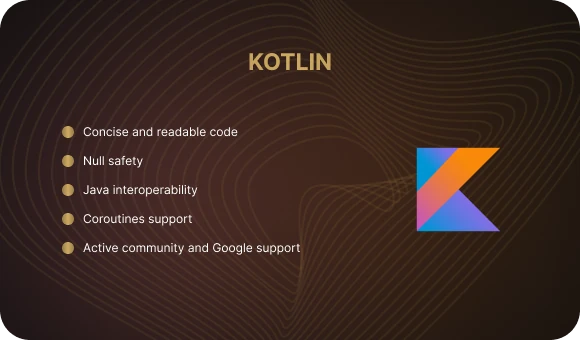
Concise and readable code
Kotlin significantly reduces the amount of boilerplate and “junk” code compared to Java. That means developers spend less time on routine tasks and more time focusing on application logic and business problems.
Built-in null safety
One of Java’s biggest pain points has always been the infamous NullPointerException, which can crash an application at runtime. Kotlin checks for possible null values at compile time, preventing many of these errors before the code even runs. This greatly improves both stability and safety.
Java interoperability
Kotlin works seamlessly with existing Java code and libraries. This allows teams to gradually migrate large projects to Kotlin without rewriting everything from scratch, saving both time and resources.
Support for modern asynchronous programming with coroutines
Asynchronous execution is essential for smooth app performance and working with databases and networks. Kotlin offers coroutines — lightweight concurrency tools that let developers write asynchronous code in a more synchronous, readable style. This simplifies maintenance and improves efficiency.
Active community and Google support
Kotlin has built a large and active developer community, while Google continues to expand and improve support for the language and its integration with Android Studio and build tools.
Who Kotlin is best for
- Teams that want to build modern Android apps with fewer bugs and more efficient code.
- Projects where flexibility matters — for example, a gradual migration from Java or integration with existing Java modules.
- Companies planning to use Kotlin Multiplatform to develop for both Android and iOS at the same time.
Kotlin has become more than just another programming language. It is now a full-fledged modern solution for mobile development that combines convenience, safety, and strong scaling potential.
Objective-C — Apple’s Legacy That Still Works
Objective-C is an older but still viable language for development within the Apple ecosystem. It remains relevant for maintaining large projects where rewriting everything in Swift is not yet practical.
Strengths
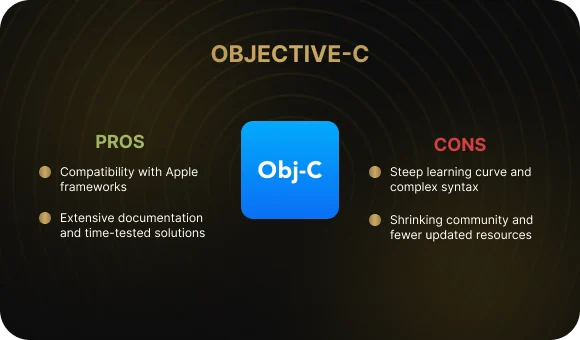
- Excellent compatibility with existing codebases and Apple frameworks.
- Strong documentation and time-tested solutions.
Weaknesses
- Non-intuitive syntax that can be difficult for beginners.
- A smaller community and fewer up-to-date learning resources.
Where it is used:
Large apps created before 2015, as well as projects where switching to Swift has not yet proven worthwhile in terms of cost versus benefit.
Java — A Classic Losing Ground
Java was the main language of Android development for more than a decade. Although it is now уступing ground to Kotlin, its importance cannot be ignored.
Advantages
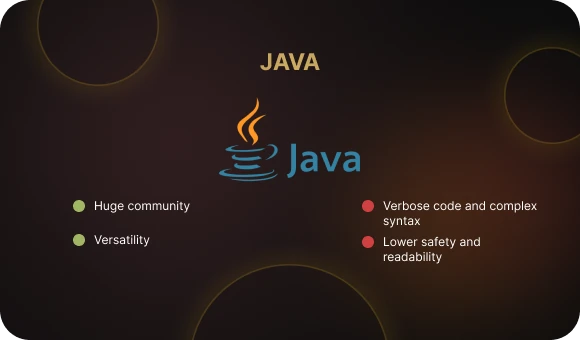
- A large community and a massive number of libraries.
- Versatility: Java is used not only for mobile apps, but also for backend and server-side systems.
Disadvantages
- More verbose code and more complex syntax.
- Lower readability and fewer safety mechanisms compared to Kotlin.
Current relevance:
Many large applications — including banking and government service apps — still use Java, especially those built before the Kotlin era.
Cross-Platform Technologies: Faster, Cheaper, Easier to Maintain
Dart and Flutter — From Prototype to Full Release
The Flutter framework, developed by Google, uses the Dart language and makes it possible to build mobile interfaces that feel almost indistinguishable from native ones, while still relying on a single codebase for both platforms. This is especially valuable when you need to test an idea quickly without sacrificing the quality of the final product.
What makes Flutter stand out
- High performance thanks to its own rendering engine, bypassing standard Android and iOS UI components.
- A wide range of widgets and flexible UI customization, allowing almost any visual style.
- Hot reload, which lets developers instantly see code changes without a full rebuild.
This combination of flexibility and fast iteration makes Flutter a convenient tool for launching products quickly and refining them on the fly.

Where Flutter is in demand
From small startups to large e-commerce platforms, Flutter is chosen for its speed, versatility, and visual flexibility. It is used by both newcomers and major brands such as BMW and eBay, especially when the goal is to launch on both mobile platforms as quickly as possible with a consistent user experience.
JavaScript and React Native — Web Experience Adapted for Mobile
React Native, developed by Meta (formerly Facebook), allows developers to build applications using JavaScript — a language familiar to virtually every frontend developer. Thanks to the ability to reuse code from web platforms, this approach has become a real bridge between the web and mobile devices.
Advantages
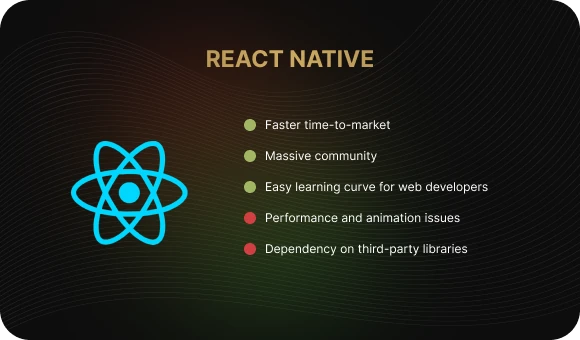
- Faster time to market.
- A huge community and support from a wide range of libraries.
- Easy to learn for web developers.
Drawbacks
- Performance and animation issues can sometimes arise.
- Strong dependence on third-party solutions.
Where it is used:
Projects like Instagram, Airbnb, and Discord either started with or were partially implemented in React Native. It is a strong choice for MVPs and products that require frequent iteration.
C# and Xamarin — Microsoft’s Enterprise Approach
Xamarin is part of the .NET family and allows developers to build cross-platform mobile applications in C#. This stack is often chosen by companies already working within the Microsoft ecosystem and looking to reduce development costs through code reuse.
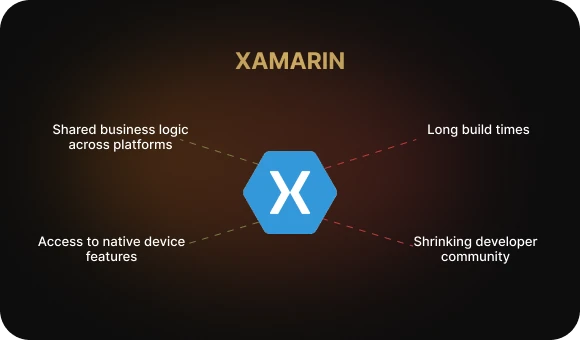
Xamarin advantages
- Shared business logic can be reused across all platforms.
- Access to native device capabilities and full UI customization.
Drawbacks
- Build times are longer compared to some other solutions.
- The community is shrinking, as many developers are moving to MAUI and Blazor.
Best suited for:
Enterprise projects, CRM and ERP integrations, and internal tools where compatibility with existing Microsoft infrastructure is important.
Alternative Languages: When a Non-Standard Approach Is Needed
In addition to the mainstream options, mobile app development sometimes involves less common but highly specialized languages. For example:
- Python via Kivy — suitable for rapid prototypes.
- Lua — actively used in game engines such as Corona SDK.
- Rust — increasingly adopted through wrappers for tasks where speed and safety are critical.
These tools are rarely used in mass-market production, but they can be useful for narrowly specialized projects or internal software.
How to Choose the Right Language for Your Project
What mobile apps are built with is not just a technical question — it is a strategic decision. To make the right choice, you should evaluate several key factors:
- Platform: Are you launching only on iOS or Android, or on both at once?
- Budget and deadlines: Cross-platform development usually saves resources, but may limit flexibility.
- Technical requirements: Do you need deep device integrations, graphics, Bluetooth, or background processing?
- Team expertise: The closer the language is to your team’s existing experience, the faster and more stable the process will be.
- Long-term goals: Do you plan to scale, release regular updates, and expand functionality?

Current Recommendations for 2026
- iOS only: Swift is the optimal choice.
- Android only: Kotlin is the industry standard.
- Both platforms at once: Flutter or React Native, depending on the team’s profile.
- Enterprise solutions: Xamarin, if you already have a .NET stack.
- Experiments and MVPs: Flutter or React Native for fast launch.
Trends and Technology Development
As of 2026, the trend is clear: native mobile programming languages such as Swift and Kotlin continue to hold strong positions, while cross-platform technologies are developing rapidly. Flutter is increasingly used even in large-scale projects, and React Native remains strong thanks to Meta’s support and its massive web developer community.

At the same time, Apple and Google continue to actively develop their SDKs and frameworks, which keeps native languages a priority for projects where performance, UX, and deep device integration matter most.
Conclusion
A mobile app is not just a software product — it is a point of contact with your audience. That is why the languages used for mobile app development are not just technologies, but part of your growth strategy.
The Beetrail team can help you choose the right tools for your project. We work with both native and cross-platform solutions, know how to launch apps from scratch, and can scale products that are already on the market.
Tell us what you want to build, and we will help you choose the ideal tech stack for your goals.
Native Development: Languages for Platform Purity
Swift — Apple’s Language, Here to Stay
When talking about the main programming languages used in mobile app development, Swift stands out as Apple’s modern alternative to Objective-C. It quickly became the primary tool for iOS development. Swift combines powerful capabilities with concise syntax, making it convenient for developers at all levels.
Why Swift is chosen
- It compiles into fast machine code, delivering excellent performance.
- Integration with Xcode and the Apple SDK helps speed up development.
- Its functional-style syntax makes code easier to read and maintain.
Drawbacks
- It only supports the Apple ecosystem.
- Frequent language updates may require regular codebase changes.
Best suited for:
Companies building iOS apps with a focus on long-term support and deep platform integration, such as banking and fintech applications.
Kotlin — Modern Android Development with Cross-Platform Ambitions
Today, Kotlin is what Android mobile apps are primarily built with. It changed the way mobile applications are developed for Google’s platform. Since 2017, when Google officially announced Kotlin as the preferred language for Android development, it has rapidly grown in popularity and gradually replaced Java in most new projects.
But Kotlin is not just for Android. It is evolving as a more universal language, capable of supporting cross-platform development through tools like Kotlin Multiplatform.
Why Kotlin is so popular among developers and companies
Concise and readable code
Kotlin significantly reduces the amount of boilerplate and “junk” code compared to Java. That means developers spend less time on routine tasks and more time focusing on application logic and business problems.
Built-in null safety
One of Java’s biggest pain points has always been the infamous NullPointerException, which can crash an application at runtime. Kotlin checks for possible null values at compile time, preventing many of these errors before the code even runs. This greatly improves both stability and safety.
Java interoperability
Kotlin works seamlessly with existing Java code and libraries. This allows teams to gradually migrate large projects to Kotlin without rewriting everything from scratch, saving both time and resources.
Support for modern asynchronous programming with coroutines
Asynchronous execution is essential for smooth app performance and working with databases and networks. Kotlin offers coroutines — lightweight concurrency tools that let developers write asynchronous code in a more synchronous, readable style. This simplifies maintenance and improves efficiency.
Active community and Google support
Kotlin has built a large and active developer community, while Google continues to expand and improve support for the language and its integration with Android Studio and build tools.
Who Kotlin is best for
- Teams that want to build modern Android apps with fewer bugs and more efficient code.
- Projects where flexibility matters — for example, a gradual migration from Java or integration with existing Java modules.
- Companies planning to use Kotlin Multiplatform to develop for both Android and iOS at the same time.
Kotlin has become more than just another programming language. It is now a full-fledged modern solution for mobile development that combines convenience, safety, and strong scaling potential.
Objective-C — Apple’s Legacy That Still Works
Objective-C is an older but still viable language for development within the Apple ecosystem. It remains relevant for maintaining large projects where rewriting everything in Swift is not yet practical.
Strengths
- Excellent compatibility with existing codebases and Apple frameworks.
- Strong documentation and time-tested solutions.
Weaknesses
- Non-intuitive syntax that can be difficult for beginners.
- A smaller community and fewer up-to-date learning resources.
Where it is used:
Large apps created before 2015, as well as projects where switching to Swift has not yet proven worthwhile in terms of cost versus benefit.
Java — A Classic Losing Ground
Java was the main language of Android development for more than a decade. Although it is now уступing ground to Kotlin, its importance cannot be ignored.
Advantages
- A large community and a massive number of libraries.
- Versatility: Java is used not only for mobile apps, but also for backend and server-side systems.
Disadvantages
- More verbose code and more complex syntax.
- Lower readability and fewer safety mechanisms compared to Kotlin.
Current relevance:
Many large applications — including banking and government service apps — still use Java, especially those built before the Kotlin era.
Cross-Platform Technologies: Faster, Cheaper, Easier to Maintain
Dart and Flutter — From Prototype to Full Release
The Flutter framework, developed by Google, uses the Dart language and makes it possible to build mobile interfaces that feel almost indistinguishable from native ones, while still relying on a single codebase for both platforms. This is especially valuable when you need to test an idea quickly without sacrificing the quality of the final product.
What makes Flutter stand out
- High performance thanks to its own rendering engine, bypassing standard Android and iOS UI components.
- A wide range of widgets and flexible UI customization, allowing almost any visual style.
- Hot reload, which lets developers instantly see code changes without a full rebuild.
This combination of flexibility and fast iteration makes Flutter a convenient tool for launching products quickly and refining them on the fly.
Where Flutter is in demand
From small startups to large e-commerce platforms, Flutter is chosen for its speed, versatility, and visual flexibility. It is used by both newcomers and major brands such as BMW and eBay, especially when the goal is to launch on both mobile platforms as quickly as possible with a consistent user experience.
JavaScript and React Native — Web Experience Adapted for Mobile
React Native, developed by Meta (formerly Facebook), allows developers to build applications using JavaScript — a language familiar to virtually every frontend developer. Thanks to the ability to reuse code from web platforms, this approach has become a real bridge between the web and mobile devices.
Advantages
- Faster time to market.
- A huge community and support from a wide range of libraries.
- Easy to learn for web developers.
Drawbacks
- Performance and animation issues can sometimes arise.
- Strong dependence on third-party solutions.
Where it is used:
Projects like Instagram, Airbnb, and Discord either started with or were partially implemented in React Native. It is a strong choice for MVPs and products that require frequent iteration.
C# and Xamarin — Microsoft’s Enterprise Approach
Xamarin is part of the .NET family and allows developers to build cross-platform mobile applications in C#. This stack is often chosen by companies already working within the Microsoft ecosystem and looking to reduce development costs through code reuse.
Xamarin advantages
- Shared business logic can be reused across all platforms.
- Access to native device capabilities and full UI customization.
Drawbacks
- Build times are longer compared to some other solutions.
- The community is shrinking, as many developers are moving to MAUI and Blazor.
Best suited for:
Enterprise projects, CRM and ERP integrations, and internal tools where compatibility with existing Microsoft infrastructure is important.
Alternative Languages: When a Non-Standard Approach Is Needed
In addition to the mainstream options, mobile app development sometimes involves less common but highly specialized languages. For example:
- Python via Kivy — suitable for rapid prototypes.
- Lua — actively used in game engines such as Corona SDK.
- Rust — increasingly adopted through wrappers for tasks where speed and safety are critical.
These tools are rarely used in mass-market production, but they can be useful for narrowly specialized projects or internal software.
How to Choose the Right Language for Your Project
What mobile apps are built with is not just a technical question — it is a strategic decision. To make the right choice, you should evaluate several key factors:
- Platform: Are you launching only on iOS or Android, or on both at once?
- Budget and deadlines: Cross-platform development usually saves resources, but may limit flexibility.
- Technical requirements: Do you need deep device integrations, graphics, Bluetooth, or background processing?
- Team expertise: The closer the language is to your team’s existing experience, the faster and more stable the process will be.
- Long-term goals: Do you plan to scale, release regular updates, and expand functionality?
Current Recommendations for 2026
- iOS only: Swift is the optimal choice.
- Android only: Kotlin is the industry standard.
- Both platforms at once: Flutter or React Native, depending on the team’s profile.
- Enterprise solutions: Xamarin, if you already have a .NET stack.
- Experiments and MVPs: Flutter or React Native for fast launch.
Trends and Technology Development
As of 2026, the trend is clear: native mobile programming languages such as Swift and Kotlin continue to hold strong positions, while cross-platform technologies are developing rapidly. Flutter is increasingly used even in large-scale projects, and React Native remains strong thanks to Meta’s support and its massive web developer community.
At the same time, Apple and Google continue to actively develop their SDKs and frameworks, which keeps native languages a priority for projects where performance, UX, and deep device integration matter most.
Conclusion
A mobile app is not just a software product — it is a point of contact with your audience. That is why the languages used for mobile app development are not just technologies, but part of your growth strategy.
The Beetrail team can help you choose the right tools for your project. We work with both native and cross-platform solutions, know how to launch apps from scratch, and can scale products that are already on the market.
Tell us what you want to build, and we will help you choose the ideal tech stack for your goals.