02.06.2026
Time to read:
9
min
How to Build Your Own Messenger from Scratch: A Complete Guide
Guides
Development
In 2025, messaging apps became a major part of daily life for billions of people. We exchange messages, share files, discuss projects, and make calls — all through convenient chats that are much faster than email. The shift to remote work, the e-commerce boom, and the growing number of mobile users have all dramatically changed the way we communicate. People no longer want to wait for an email reply or struggle through contact forms — they want a fast and secure communication channel, and messaging apps solve that need perfectly.
A modern messenger is a product that combines a wide range of features: instant messaging, file sharing, group chats, voice and video calls, and integrations with other services. Most importantly, it has to be intuitive, reliable, and secure. At a time when users are becoming increasingly sensitive to issues of security and privacy, development must also include features such as end-to-end encryption, disappearing messages, and two-factor authentication.
What does it take to build a messaging app in 2026? In this article, we will walk through the key stages of development — from market analysis to technology selection — and look at standard features, monetization models, trends, and competitor examples.
Why Build Yet Another Messenger?
Today, more than 5.1 billion people use messaging apps — nearly 63% of the world’s population. Around 80% of adults aged 19 to 64 open these apps every day and spend 2 to 3 hours there. Among teenagers aged 13 to 18, engagement is even higher: up to 91% chat daily. At the same time, most people do not install just one messenger — they use anywhere from two to five for different purposes. The market is mature, active, and still growing.
In that context, the idea of building yet another messenger may seem risky — but only at first glance. In practice, users are looking for new tools that solve their specific needs more precisely, from private communication to workflow automation. More and more often, messenger development is tailored to a specific audience, business model, or internal infrastructure. It may be a secure corporate chat, a communication channel for a school, a niche solution with a custom interface, or an app deeply integrated with a company’s services.
Chatbots, Channels, AI: What’s Trending
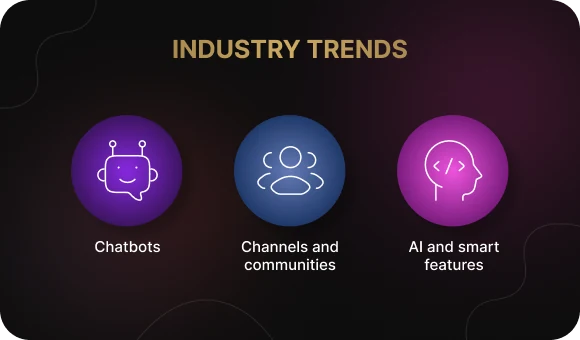
Modern messengers have long evolved beyond simple text messaging. The main trends of 2023–2025 include:
- Chatbots and automation. Companies are increasingly embedding bots into apps to reduce the load on support teams and speed up customer service.
- Public channels and communities. Telegram and WhatsApp are expanding broadcast-style models for subscribers. Messengers are becoming more like social networks.
- AI and smart features. Auto-translation, suggestions, and summaries are making chats more flexible and functional. This is especially valuable for workplace scenarios: teams can navigate long conversations more easily, capture decisions, and move faster.
These trends matter to anyone planning to build their own product: users expect a tool that addresses specific needs more precisely than universal solutions do.
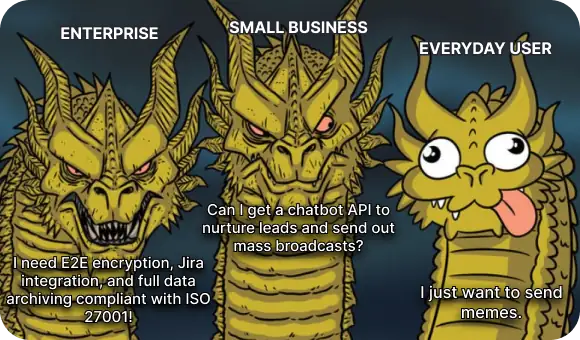
Who Are You Building It For?
If you want to create a messenger people will actually use, start by understanding who it is for.
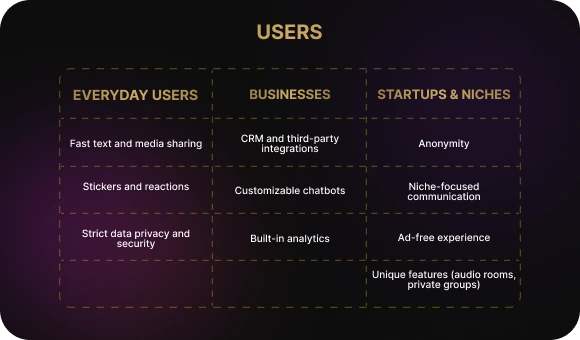
Private users: simple, fast, and private
Most users want one thing: convenient, secure, and functional communication. What matters to them is the ability to:
- send text and media quickly,
- find the right contacts easily,
- use stickers, reactions, and disappearing messages,
- feel confident that everything is encrypted and unreadable to outsiders.
Personal messengers should create a sense of control and trust.
Business: support lives where the customer is
Small and large companies use messengers as a sales and support channel — it is easier for customers to send a message than to call or wait for an email. That is why businesses care about:
- integrations with CRM and other systems, so conversations are linked to customer profiles,
- chatbot configuration, for handling routine questions automatically,
- built-in analytics, to track response speed, satisfaction, and reasons for contact.
For business, communication is only part of the picture — data handling matters too: chat history, analytics, reports. When building a messenger for companies, it is also important to consider security and compliance, including standards such as GDPR.
Startups and niches: smaller, but more precise
Interest in custom mobile apps continues to grow. Small teams are launching messengers for gamers, activists, students, developers, and interest-based communities. These users often value:
- anonymity,
- focus on a specific topic,
- the absence of unnecessary elements such as ads and trackers,
- unique features such as audio chats, private groups, or interface customization.
New approaches and formats are often born in these niches before being adopted by larger players. So yes, even a narrow target audience can be enough — as long as you know why you are building for them.
Who Is Already on the Market: Competitors’ Strengths and Weaknesses
If you plan to launch a new messenger, it is important to understand who you are competing with. Today, the market includes dozens of major and niche players. Each has its own audience, style, and weak points you may be able to exploit.
WhatsApp: stability and simplicity
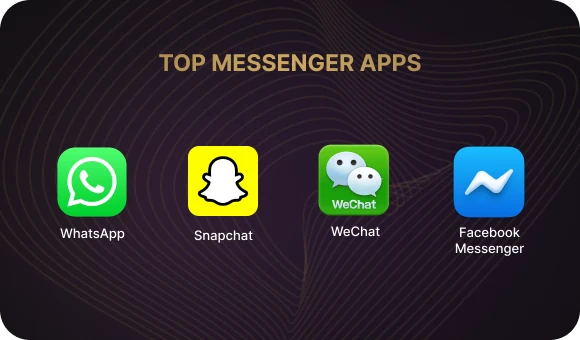
The most popular messenger in the world, with more than 3 billion monthly users. People value its simple interface, reliability, and default end-to-end encryption. But WhatsApp has weaknesses too: new features arrive slowly, the design barely changes, and customization is almost nonexistent.
Telegram: a messenger with the ambition of a social platform
Unlike WhatsApp, which focuses on private chats, Telegram is evolving into a super app. It offers public channels, groups, bots, cloud storage, interface customization, and mini apps. This creates broad opportunities for content distribution and for building services inside its ecosystem. Telegram’s main strength is flexibility and feature depth, but those also create vulnerabilities: spam, duplicate channels, and fake content.
WeChat: a messenger on steroids
In China, WeChat is everything: messaging, social networking, payments, public services, gaming, and food delivery. It is a super app users rarely need to leave. Outside China, WeChat has limited reach, but its model is highly influential: a messenger can become a full digital ecosystem. That model requires building multiple directions at once — messaging, payments, and mini-services.
Facebook Messenger: strong integration, weaker privacy
Messenger is tightly integrated with Facebook and Instagram, making it convenient for communicating with followers, receiving notifications, and reacting to content. But in terms of security, it falls short: end-to-end encryption is not enabled by default and exists only in separate “secret” chats. Younger users are moving to other platforms, and Messenger is gradually losing relevance, partly because of outdated product and development decisions.
What Users Need: More Than Just Messages
Different user groups have different goals. To build an app people will actually use, you need to understand who will come to it and why.
Private users: privacy and effortless communication
For everyday use, the app needs to be fast, convenient, and secure. Users expect:
- instant delivery of messages, photos, videos, and voice notes,
- end-to-end encryption by default,
- disappearing messages with a timer,
- the ability to hide their profile and limit access for certain contacts,
- no built-in ads or tracking.
Business: automation and integration
For companies, a messenger is a full-fledged work tool. Such an app should provide:
- integrations with CRM and other services,
- APIs for chatbots, auto-replies, and business messaging,
- built-in analytics on customer interaction,
- compliance with security and data privacy requirements.
Corporate users: secure collaboration
In internal communication, reliability and control are critical. A team messenger should support:
- secure group chats with moderation tools,
- end-to-end encryption and flexible access rights,
- integrations with task trackers, calendars, and internal systems,
- automatic chat archiving and compliance with data retention standards.
Which Features Make a Messenger Valuable
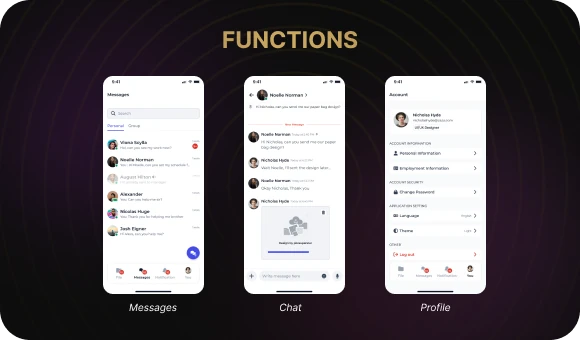
If you are figuring out how to build your own messenger from scratch, it is important to define the feature set in advance. This section covers the capabilities a typical app includes and what to keep in mind during development.
Core features
Authentication
Login via phone number, email, or social accounts. Contact import for a faster start.
Messaging
Text messages, delivery statuses, chat history, editing, and group chats.
File sharing
Photos, videos, documents, and location sharing in just a few taps.
Notifications
Push notifications with customizable settings.
Security
End-to-end encryption, chat protection, and two-factor authentication.
Advanced features
Calls
Voice and video calls, including group calls, with support for weak internet connections.
Chatbots
Task automation and the ability to create custom bots via API.
Channels and groups
Public communities for content creation and promotion inside the app.
Disappearing messages
Auto-delete timers for private conversations.
Integrations
CRM, cloud services, analytics, payments — everything that makes the product more useful in real workflows.
Interface and Experience
Even the most powerful features will not save an app if it is hard to use. Your goal is an interface that needs no explanation:
- minimalist design,
- fast performance,
- dark and light themes,
- offline mode,
- stable operation on Android, iOS, and the web.
From Idea to Product: Messenger Development Stages and Timelines
If you want to understand how to build your own messenger for Android and other platforms, the process typically consists of five stages involving a team of designers, analysts, developers, and testers. Together, they shape the logic, interface, stability, and security that ultimately define the product’s quality.
1. Research and planning
Typical duration: 2–4 weeks
What happens:
This stage is the foundation of the entire project, and it starts with key questions: who will use the app? why do they need another messenger? which features are essential, and which can wait?
First, the analyst researches the market, competitors, and current user needs. Then the team studies trends and identifies weaknesses in existing solutions. Based on the findings, they prepare a technical specification, outline usage scenarios, and define the MVP scope. This makes it possible to estimate workload, timeline, and approximate development cost in advance. At the same time, wireframes are created to reflect the app’s structure and logic.
2. Design
Typical duration: 3–6 weeks
What happens:
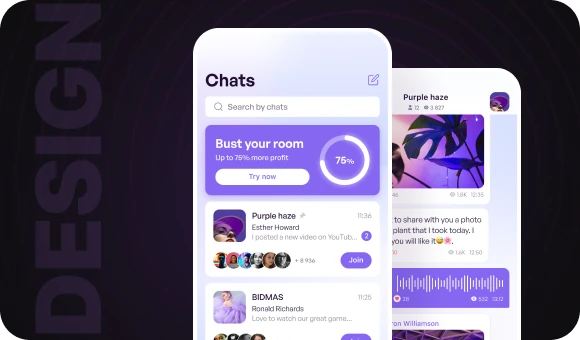
- UX flows are designed: login, search, messaging, and contact management.
- The visual style is created: chats, buttons, profile, attachments.
- The design is adapted for mobile platforms such as iOS and Android, as well as the web.
- A prototype is assembled in Figma.
At this stage, the priority is to create intuitive interaction logic. The ease of use of the interface shapes first impressions, adoption speed, and user engagement.
3. Development
Typical duration: 10–20 weeks
What happens:
The development team writes the code, builds the infrastructure, and connects everything into a unified product.
Frontend development (6–12 weeks): React Native is often used because it allows one codebase for both Android and iOS. For the web, teams typically use React or another SPA framework. These tools speed up cross-platform development and make updates easier to release.
Backend development (4–8 weeks): Common languages include Node.js, Python, Go, and Java. For real-time communication, teams use WebSocket or gRPC.
The main features are implemented:
- authentication,
- chats,
- notifications,
- integrations,
- encryption,
- APIs for bots and connected services.
The infrastructure is also configured: servers, databases, file storage, and protection against DDoS attacks and security vulnerabilities.
By this point, you can already see how the app performs in terms of speed, responsiveness, and scalability.
4. Testing
Typical duration: 4–6 weeks
What happens:
Testing is what turns a prototype into a real application. No development process is complete without these steps:
Functional testing: the team checks how the app behaves in key scenarios. Message delivery, calls, and file transfers must all work reliably: messages arrive, calls stay connected, and files are not corrupted.
Load testing: the team evaluates how the system handles high simultaneous demand, such as 10,000+ connections, whether the server remains stable, and whether the database encounters failures. This is especially important for large-scale products.
Cross-platform testing: the app is checked on Android, iOS, and in the browser to ensure it behaves and looks consistent across platforms, with no critical differences in interface or logic.
Everything needs testing: registration, UI, server interaction, push notifications. It is also important to test negative scenarios such as slow mobile internet, low memory on the device, and dropped connections.
5. Launch and support
Typical duration: 2–3 weeks
What happens:
A messenger is considered launched when it is published in the App Store, Google Play, and as a web version. But the team’s work continues through updates, improvements, and ongoing testing. At this stage:
- feedback from early users is collected,
- bugs are fixed,
- updates are released every few weeks, ranging from small fixes to major features such as AI bots or custom themes.
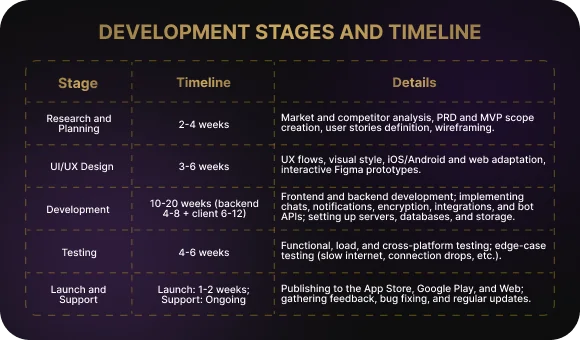
On average, the full development cycle of a messenger — from research to launch — takes 5 to 8 months. The exact timeframe depends on feature complexity, the number of platforms, and how clearly the project is defined from the start.
If you are building a messenger yourself, remember: every phase matters. Mistakes made early on lead to losses later. So do not rush — build on a solid foundation.
Promotion and Monetization: How to Make a Messenger Successful
After launch, it is important to understand how the app will grow and make money. The monetization model should ideally be planned in advance, because it affects features, design, and the final cost of the product.
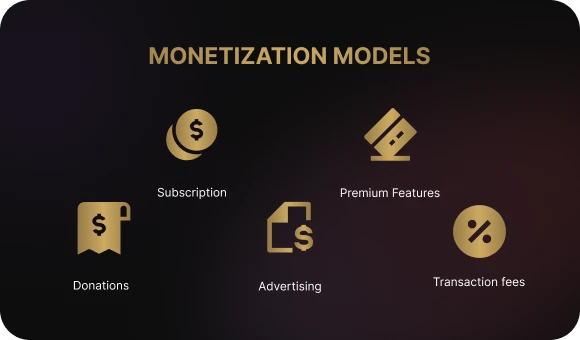
Monetization models
Advertising
Built-in banners, sponsored messages, and partner placements inside chats and channels.
Subscription
Ad-free usage and advanced features such as voice transcription, stories, premium emojis, and privileges for channel owners. Pricing needs to be reasonable.
In-app purchases
Stickers, themes, and bots — monetization that does not disrupt the core communication experience.
Commissions
Revenue from paid calls, business integrations, and connections such as CRM integrations.
Donations
Users support creators, and part of the money goes toward product development. This works well for smaller projects with an independent model.
How to Promote a Messenger
A good app needs more than development — it also needs promotion, otherwise no one will know it exists.
- SEO and ASO. Search optimization and a well-crafted app store listing.
- Advertising and influencers. Promotion through social media, Google Ads, YouTube, and partner reviews.
- Retention. Notifications, friend invites, regular updates, and active feedback management.
Well-structured marketing helps not only bring the app to market, but also retain users without relying constantly on paid traffic. As a result, acquisition costs go down, engagement goes up, and promotion becomes sustainable even with a limited budget.
Conclusion
Building a messenger opens the door to a product that can connect users and generate revenue through thoughtful monetization. If you are thinking about how to create your own messenger, it is important to assess your goals, audience, and technical capabilities. We can help you develop a messenger with unique features and a reliable architecture. Want to stand out in the market? Contact us today for a project estimate.
Why Build Yet Another Messenger?
Today, more than 5.1 billion people use messaging apps — nearly 63% of the world’s population. Around 80% of adults aged 19 to 64 open these apps every day and spend 2 to 3 hours there. Among teenagers aged 13 to 18, engagement is even higher: up to 91% chat daily. At the same time, most people do not install just one messenger — they use anywhere from two to five for different purposes. The market is mature, active, and still growing.
In that context, the idea of building yet another messenger may seem risky — but only at first glance. In practice, users are looking for new tools that solve their specific needs more precisely, from private communication to workflow automation. More and more often, messenger development is tailored to a specific audience, business model, or internal infrastructure. It may be a secure corporate chat, a communication channel for a school, a niche solution with a custom interface, or an app deeply integrated with a company’s services.
Chatbots, Channels, AI: What’s Trending
Modern messengers have long evolved beyond simple text messaging. The main trends of 2023–2025 include:
- Chatbots and automation. Companies are increasingly embedding bots into apps to reduce the load on support teams and speed up customer service.
- Public channels and communities. Telegram and WhatsApp are expanding broadcast-style models for subscribers. Messengers are becoming more like social networks.
- AI and smart features. Auto-translation, suggestions, and summaries are making chats more flexible and functional. This is especially valuable for workplace scenarios: teams can navigate long conversations more easily, capture decisions, and move faster.
These trends matter to anyone planning to build their own product: users expect a tool that addresses specific needs more precisely than universal solutions do.
Who Are You Building It For?
If you want to create a messenger people will actually use, start by understanding who it is for.
Private users: simple, fast, and private
Most users want one thing: convenient, secure, and functional communication. What matters to them is the ability to:
- send text and media quickly,
- find the right contacts easily,
- use stickers, reactions, and disappearing messages,
- feel confident that everything is encrypted and unreadable to outsiders.
Personal messengers should create a sense of control and trust.
Business: support lives where the customer is
Small and large companies use messengers as a sales and support channel — it is easier for customers to send a message than to call or wait for an email. That is why businesses care about:
- integrations with CRM and other systems, so conversations are linked to customer profiles,
- chatbot configuration, for handling routine questions automatically,
- built-in analytics, to track response speed, satisfaction, and reasons for contact.
For business, communication is only part of the picture — data handling matters too: chat history, analytics, reports. When building a messenger for companies, it is also important to consider security and compliance, including standards such as GDPR.
Startups and niches: smaller, but more precise
Interest in custom mobile apps continues to grow. Small teams are launching messengers for gamers, activists, students, developers, and interest-based communities. These users often value:
- anonymity,
- focus on a specific topic,
- the absence of unnecessary elements such as ads and trackers,
- unique features such as audio chats, private groups, or interface customization.
New approaches and formats are often born in these niches before being adopted by larger players. So yes, even a narrow target audience can be enough — as long as you know why you are building for them.
Who Is Already on the Market: Competitors’ Strengths and Weaknesses
If you plan to launch a new messenger, it is important to understand who you are competing with. Today, the market includes dozens of major and niche players. Each has its own audience, style, and weak points you may be able to exploit.
WhatsApp: stability and simplicity
The most popular messenger in the world, with more than 3 billion monthly users. People value its simple interface, reliability, and default end-to-end encryption. But WhatsApp has weaknesses too: new features arrive slowly, the design barely changes, and customization is almost nonexistent.
Telegram: a messenger with the ambition of a social platform
Unlike WhatsApp, which focuses on private chats, Telegram is evolving into a super app. It offers public channels, groups, bots, cloud storage, interface customization, and mini apps. This creates broad opportunities for content distribution and for building services inside its ecosystem. Telegram’s main strength is flexibility and feature depth, but those also create vulnerabilities: spam, duplicate channels, and fake content.
WeChat: a messenger on steroids
In China, WeChat is everything: messaging, social networking, payments, public services, gaming, and food delivery. It is a super app users rarely need to leave. Outside China, WeChat has limited reach, but its model is highly influential: a messenger can become a full digital ecosystem. That model requires building multiple directions at once — messaging, payments, and mini-services.
Facebook Messenger: strong integration, weaker privacy
Messenger is tightly integrated with Facebook and Instagram, making it convenient for communicating with followers, receiving notifications, and reacting to content. But in terms of security, it falls short: end-to-end encryption is not enabled by default and exists only in separate “secret” chats. Younger users are moving to other platforms, and Messenger is gradually losing relevance, partly because of outdated product and development decisions.
What Users Need: More Than Just Messages
Different user groups have different goals. To build an app people will actually use, you need to understand who will come to it and why.
Private users: privacy and effortless communication
For everyday use, the app needs to be fast, convenient, and secure. Users expect:
- instant delivery of messages, photos, videos, and voice notes,
- end-to-end encryption by default,
- disappearing messages with a timer,
- the ability to hide their profile and limit access for certain contacts,
- no built-in ads or tracking.
Business: automation and integration
For companies, a messenger is a full-fledged work tool. Such an app should provide:
- integrations with CRM and other services,
- APIs for chatbots, auto-replies, and business messaging,
- built-in analytics on customer interaction,
- compliance with security and data privacy requirements.
Corporate users: secure collaboration
In internal communication, reliability and control are critical. A team messenger should support:
- secure group chats with moderation tools,
- end-to-end encryption and flexible access rights,
- integrations with task trackers, calendars, and internal systems,
- automatic chat archiving and compliance with data retention standards.
Which Features Make a Messenger Valuable
If you are figuring out how to build your own messenger from scratch, it is important to define the feature set in advance. This section covers the capabilities a typical app includes and what to keep in mind during development.
Core features
Authentication
Login via phone number, email, or social accounts. Contact import for a faster start.
Messaging
Text messages, delivery statuses, chat history, editing, and group chats.
File sharing
Photos, videos, documents, and location sharing in just a few taps.
Notifications
Push notifications with customizable settings.
Security
End-to-end encryption, chat protection, and two-factor authentication.
Advanced features
Calls
Voice and video calls, including group calls, with support for weak internet connections.
Chatbots
Task automation and the ability to create custom bots via API.
Channels and groups
Public communities for content creation and promotion inside the app.
Disappearing messages
Auto-delete timers for private conversations.
Integrations
CRM, cloud services, analytics, payments — everything that makes the product more useful in real workflows.
Interface and Experience
Even the most powerful features will not save an app if it is hard to use. Your goal is an interface that needs no explanation:
- minimalist design,
- fast performance,
- dark and light themes,
- offline mode,
- stable operation on Android, iOS, and the web.
From Idea to Product: Messenger Development Stages and Timelines
If you want to understand how to build your own messenger for Android and other platforms, the process typically consists of five stages involving a team of designers, analysts, developers, and testers. Together, they shape the logic, interface, stability, and security that ultimately define the product’s quality.
1. Research and planning
Typical duration: 2–4 weeks
What happens:
This stage is the foundation of the entire project, and it starts with key questions: who will use the app? why do they need another messenger? which features are essential, and which can wait?
First, the analyst researches the market, competitors, and current user needs. Then the team studies trends and identifies weaknesses in existing solutions. Based on the findings, they prepare a technical specification, outline usage scenarios, and define the MVP scope. This makes it possible to estimate workload, timeline, and approximate development cost in advance. At the same time, wireframes are created to reflect the app’s structure and logic.
2. Design
Typical duration: 3–6 weeks
What happens:
- UX flows are designed: login, search, messaging, and contact management.
- The visual style is created: chats, buttons, profile, attachments.
- The design is adapted for mobile platforms such as iOS and Android, as well as the web.
- A prototype is assembled in Figma.
At this stage, the priority is to create intuitive interaction logic. The ease of use of the interface shapes first impressions, adoption speed, and user engagement.
3. Development
Typical duration: 10–20 weeks
What happens:
The development team writes the code, builds the infrastructure, and connects everything into a unified product.
Frontend development (6–12 weeks): React Native is often used because it allows one codebase for both Android and iOS. For the web, teams typically use React or another SPA framework. These tools speed up cross-platform development and make updates easier to release.
Backend development (4–8 weeks): Common languages include Node.js, Python, Go, and Java. For real-time communication, teams use WebSocket or gRPC.
The main features are implemented:
- authentication,
- chats,
- notifications,
- integrations,
- encryption,
- APIs for bots and connected services.
The infrastructure is also configured: servers, databases, file storage, and protection against DDoS attacks and security vulnerabilities.
By this point, you can already see how the app performs in terms of speed, responsiveness, and scalability.
4. Testing
Typical duration: 4–6 weeks
What happens:
Testing is what turns a prototype into a real application. No development process is complete without these steps:
Functional testing: the team checks how the app behaves in key scenarios. Message delivery, calls, and file transfers must all work reliably: messages arrive, calls stay connected, and files are not corrupted.
Load testing: the team evaluates how the system handles high simultaneous demand, such as 10,000+ connections, whether the server remains stable, and whether the database encounters failures. This is especially important for large-scale products.
Cross-platform testing: the app is checked on Android, iOS, and in the browser to ensure it behaves and looks consistent across platforms, with no critical differences in interface or logic.
Everything needs testing: registration, UI, server interaction, push notifications. It is also important to test negative scenarios such as slow mobile internet, low memory on the device, and dropped connections.
5. Launch and support
Typical duration: 2–3 weeks
What happens:
A messenger is considered launched when it is published in the App Store, Google Play, and as a web version. But the team’s work continues through updates, improvements, and ongoing testing. At this stage:
- feedback from early users is collected,
- bugs are fixed,
- updates are released every few weeks, ranging from small fixes to major features such as AI bots or custom themes.
On average, the full development cycle of a messenger — from research to launch — takes 5 to 8 months. The exact timeframe depends on feature complexity, the number of platforms, and how clearly the project is defined from the start.
If you are building a messenger yourself, remember: every phase matters. Mistakes made early on lead to losses later. So do not rush — build on a solid foundation.
Promotion and Monetization: How to Make a Messenger Successful
After launch, it is important to understand how the app will grow and make money. The monetization model should ideally be planned in advance, because it affects features, design, and the final cost of the product.
Monetization models
Advertising
Built-in banners, sponsored messages, and partner placements inside chats and channels.
Subscription
Ad-free usage and advanced features such as voice transcription, stories, premium emojis, and privileges for channel owners. Pricing needs to be reasonable.
In-app purchases
Stickers, themes, and bots — monetization that does not disrupt the core communication experience.
Commissions
Revenue from paid calls, business integrations, and connections such as CRM integrations.
Donations
Users support creators, and part of the money goes toward product development. This works well for smaller projects with an independent model.
How to Promote a Messenger
A good app needs more than development — it also needs promotion, otherwise no one will know it exists.
- SEO and ASO. Search optimization and a well-crafted app store listing.
- Advertising and influencers. Promotion through social media, Google Ads, YouTube, and partner reviews.
- Retention. Notifications, friend invites, regular updates, and active feedback management.
Well-structured marketing helps not only bring the app to market, but also retain users without relying constantly on paid traffic. As a result, acquisition costs go down, engagement goes up, and promotion becomes sustainable even with a limited budget.
Conclusion
Building a messenger opens the door to a product that can connect users and generate revenue through thoughtful monetization. If you are thinking about how to create your own messenger, it is important to assess your goals, audience, and technical capabilities. We can help you develop a messenger with unique features and a reliable architecture. Want to stand out in the market? Contact us today for a project estimate.