02.06.2026
Time to read:
9
min
Freight Transportation Service Development: From Idea to Launch
Development
Guides
In 2023, the global market for digital services used to find and organize freight transportation reached $4.2 billion. According to forecasts, it is expected to grow to $7.5 billion by 2026 and may exceed $60 billion by 2034. This growth points to one clear trend: logistics is rapidly moving online.
The first major push behind this shift was the pandemic, when businesses had to rebuild supply chains and find ways to operate with fewer in-person interactions. Today, demand for online logistics is being driven by the continued growth of e-commerce. More and more purchases are made online, which means more orders, more complex routes, and higher expectations for speed and accuracy. To handle this volume, companies need tools that are flexible, fast, and easy to use.
That is why digital platforms are coming to the forefront — freight transportation services that bring shippers and carriers together in a single system. These platforms help speed up operations, reduce costs, and make logistics more convenient for both customers and drivers.
In this article, we will look at how the digital freight market works, which features a transportation app needs, how development typically unfolds, and how such a service can generate profit.

The Digital Freight Market: Trends and Audience
Anyone who has ever had to organize a shipment knows how complex the process can be. Accuracy in routing, meeting deadlines, handling documents correctly, and coordinating all participants are essential. Even a small mistake can lead to delayed deliveries or financial losses.
To avoid this, companies are looking for tools that simplify logistics management. More and more often, that solution is a freight transportation app — a digital aggregator that acts as a next-generation freight exchange, connecting shippers and carriers in one system. Customers post shipment requests, while carriers respond and receive orders directly.
Who Will Use This Kind of App?
To understand how the app should work, you first need to define its target audience. In the case of a freight-matching platform, the audience is two-sided:
1. Shippers
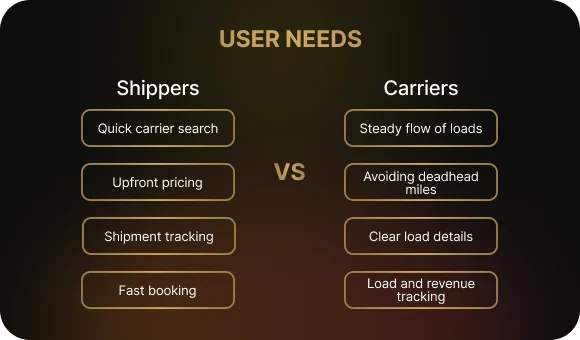
These are the people or businesses that need to move cargo: companies, warehouses, retailers, or private customers. Their main needs are:
- quickly finding an available carrier with the right vehicle;
- knowing the price in advance;
- seeing where the cargo is;
- placing orders without phone calls or paperwork.
For them, the app needs to be simple and reliable, so they can arrange freight transportation without being distracted from their core work.
2. Carriers
These are drivers and fleet owners. Their priorities are different:
- getting a steady flow of orders;
- avoiding empty runs;
- clearly understanding price, route, and deadlines;
- being able to track orders and income.
Many carriers are sole proprietors working on their own. They do not have a dispatcher or an IT department, which is why driver-focused freight apps are especially in demand. These solutions combine navigation, access to orders, analytics, and everything else needed for day-to-day work on the road.
Market Leaders: Who Got It Right — and Who Did Not
There are already strong players in the digital freight market that are worth looking at. Let’s take a look at how their services are built.
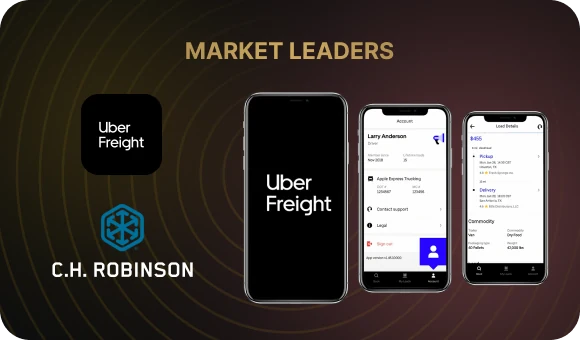
Uber Freight — “Uber for cargo”
When Uber entered the freight market, it applied the same model it used in ride-hailing: drivers and customers find each other through the app, without intermediaries. The service operates in the US and Europe and connects tens of thousands of drivers and shippers.
What Uber Freight offers:
- simple driver onboarding;
- search and booking in just a couple of taps;
- transparent pricing without negotiations;
- cargo tracking;
- additional features such as trailer rentals, fuel discounts, and analytics.
It is a full ecosystem where users get not only orders, but also tools for managing their work.
C.H. Robinson — the digital transformation of a logistics giant
C.H. Robinson is one of the world’s largest transportation partners, with revenue of around $24.7 billion in 2022. The company spent decades operating as a traditional freight forwarder, but in recent years it has invested heavily in digital transformation. Its ecosystem includes the Navisphere platform, a mobile app for carriers, and Freightquote, which allows small businesses to calculate rates and book shipments with real-time tracking on their own.
To stay competitive, C.H. Robinson is investing hundreds of millions of dollars in AI and service automation. Despite a drop in profit in 2023, the company continues to develop digital solutions and strengthen its market position.
The Russian Market: Digitalization Is Advancing, but Unevenly
In Russia and the CIS, digital logistics solutions are developing more slowly than in Western markets, but interest in them is steadily growing. For a long time, the main tool for finding carriers was freight exchanges — for example, ATI.su, which remains the largest platform in the market. It is essentially a freight service marketplace where users can post requests, verify counterparties, and choose carriers based on ratings.
Mobile solutions designed to replace traditional freight exchanges are also emerging. For example, the startup Deliver attempted as early as 2016 to create a Russian equivalent of Uber Freight — an app that directly connects customers and drivers. These kinds of platforms simplify access to orders and allow users to work without intermediaries, but they have not yet reached mass adoption.
The challenge is that the market is highly fragmented, and most processes are still handled manually — through phone calls, messengers, and paper documents. This slows operations, increases costs, and reduces transparency. At the same time, demand for simple and reliable digital tools is growing, which only increases interest in platforms that make freight transportation easier.
What matters here is that the Russian market still does not have a single dominant leader among freight apps. That means new services still have a real chance to capture a large niche.
What Features Does a Freight App Need?
When users install a freight service app, they do not just expect a list of available shipments. They want a tool that helps them quickly solve specific tasks — finding transport, booking shipments, tracking cargo, and receiving payment. That is why development must take the needs of all user groups into account.
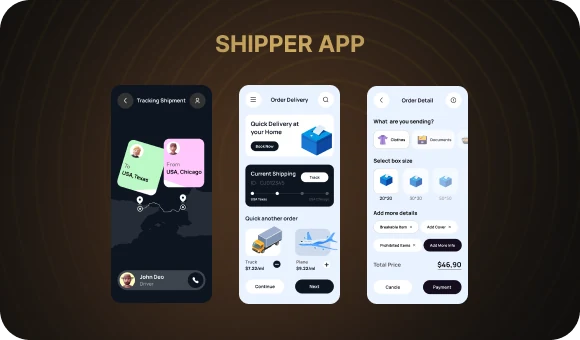
For shippers
These are the clients who need to transport cargo:
- registration and a personal profile with company details and contact information;
- request creation with cargo type, route, deadlines, and budget;
- vehicle search with filters such as load capacity, region, and transport type;
- comparison and filtering of carrier offers by price, timing, and rating;
- cargo tracking via GPS;
- convenient online payments with confirmation and receipts;
- shared account management with partners and colleagues, including access rights;
- a review system for evaluating carriers after delivery.
For carriers
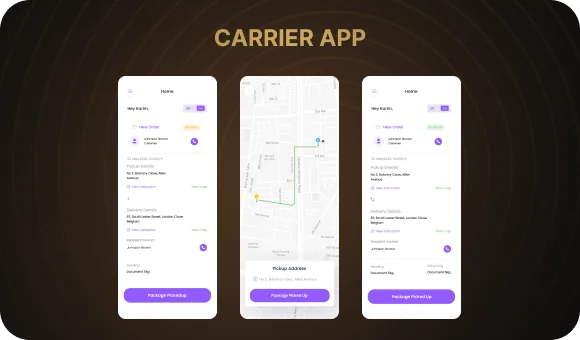
These are drivers, sole proprietors, and transportation companies:
- registration with verification, including document, license, and tax ID upload;
- an order catalog with filters by region, cargo type, and price;
- quick response to shipment requests without calls or back-and-forth coordination;
- fleet management if there are multiple vehicles;
- navigation and route planning with map integrations;
- trip history with dates, routes, and delivered cargo;
- financial analytics, including income, trip history, and expense tracking;
- notifications about new orders to avoid missing relevant jobs.
For platform administrators
- moderation, including carrier verification and complaint handling;
- analytics, including order statistics by region, time, and client type;
- fast technical support and user data protection.
This role distribution makes it possible to build freight services that are useful for everyone involved — both the ones moving cargo and the ones ordering the shipment.
How the Service Is Built: Step by Step
Developing a digital freight platform is a structured process in which technology alone is not enough — understanding real user needs matters just as much. Here are the main stages a team goes through when creating a stable and user-friendly platform.
1. Research and planning
At the first stage, the team dives into the needs of future users and defines how the service will work. The goal is not just to collect ideas, but to understand the real needs of each side.
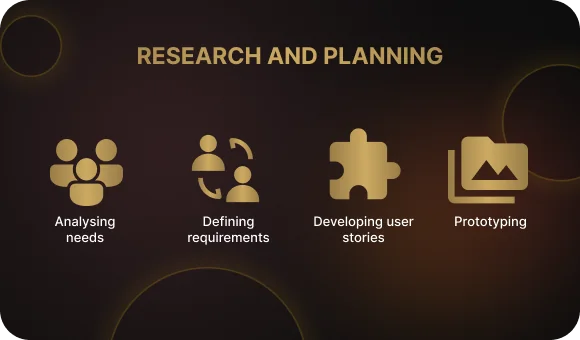
What happens at this stage:
- Needs analysis: the team studies the workflows of shippers and carriers and identifies key pain points and requests.
- Requirements definition: based on that analysis, the team creates clear descriptions of what the app should be able to do.
- User stories: simple stories are used to describe user behavior. For example:
- “I am a warehouse owner, and I want to quickly find the right vehicle for my cargo.”
- “I am a driver, and I want to receive notifications about orders in my region.”
- Prototype creation: early screen layouts are designed so the team can see what the interface will look like and how users will move through the platform.
2. Design
Once it becomes clear which functions really matter, the team starts working on the visual side of the service. Simplicity and usability are the main priorities. In practice, a logistics app becomes an everyday work tool for drivers and managers. Its clarity and convenience directly affect operating speed and delivery accuracy.
The design process takes several key principles into account:
- Clear navigation: users should immediately understand where to create a request, check a route, or contact a customer or carrier.
- Responsiveness: the interface should be equally convenient on smartphones, tablets, and the web, since some users work with the service on the go while others use it from the office.
- Visual clarity: thoughtful typography, color accents, and contrast help the interface support the task rather than overwhelm the user.
3. Development
The next stage is implementing all planned features. The team builds:
- search and filtering for vehicles and shipment requests, so users can quickly find relevant offers;
- route and price calculation based on distance, cargo weight, and transport type;
- integrations with maps, payment systems, notification services, and external partners.
This is also where the technical foundation is built: the platform needs to operate reliably and handle a large number of users.
4. Testing
Before launch, everything is carefully tested:
- each feature is tested, from creating a shipment request to making a payment;
- load testing is carried out to ensure the service does not slow down even when many users are active at the same time;
- the app is tested on different devices and in different browsers.
Testing helps ensure that the platform will be convenient and intuitive regardless of where or how it is used.

5. Launch and support
After all stages are complete, the service becomes available in the App Store, Google Play, and through a web version. But the work does not stop there.
The team tracks how users interact with the app, collects feedback, answers questions, and releases updates. With each cycle, the service becomes more convenient, faster, and better at solving user needs.
How to Monetize It: Revenue Models
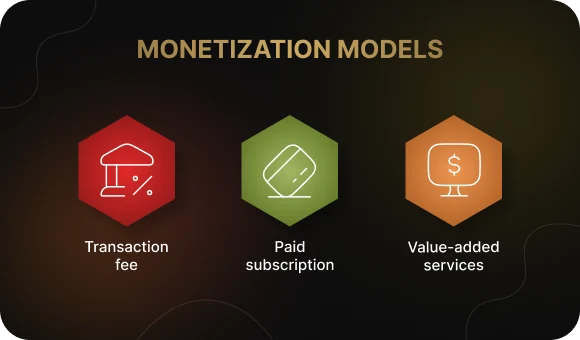
A freight-matching service can generate revenue in several ways. Here are a few common models:
Commission per transaction
This is the classic approach: the platform keeps a percentage from every shipment. For example, if the customer pays 5,000 rubles, the platform may retain 250 rubles. It is straightforward and transparent.
Subscription
Carriers can be offered paid access to advanced features such as search priority, access to large orders, and exclusive offers outside public exchanges. The package may also include tools for more effective fleet management, such as load tracking, trip monitoring, and maintenance reminders. This can be offered as a monthly or annual subscription.
Additional services
These may include:
- promoted placement — carriers can pay to appear above competitors in search results;
- advanced analytics — reports on income, average trip duration, vehicle utilization, order geography, and price trends by route;
- legal support — document verification and contract templates;
- integrations with 1C or other systems, which is especially relevant for businesses.
If pricing is structured well, the service can generate revenue at every stage of user interaction.
How to Attract and Retain Users
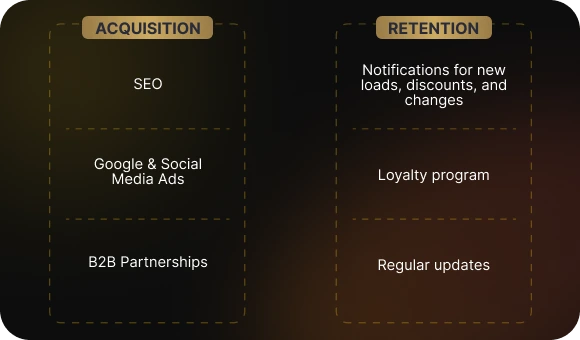
Development is only half the job. For the service to start working, users need to find it and begin using it. That is why marketing tools matter.
Acquisition
- SEO — so that users searching for “freight transportation service” find your platform.
- Google and social media ads — targeted by region and audience type.
- Partnerships with companies — for example, warehouses or marketplaces.
Retention
- notifications about new orders, discounts, and updates;
- a loyalty program with bonuses for completed deliveries, ratings, and reward points that can be used for future trips or discounts;
- regular updates to keep the app from becoming outdated.
The more convenient the service is, the more willing users will be to come back to it.
Conclusion: Why Launching Your Own Service Makes Sense
Any freight app idea can become successful if it is implemented the right way. We build aggregators that connect shippers and carriers while delivering convenience, transparency, and efficiency.
From market analysis to platform launch, we create solutions that are ready to scale.
Want an app that takes your logistics business to the next level? Contact us, and we will build an aggregator perfectly tailored to your needs.
The Digital Freight Market: Trends and Audience
Anyone who has ever had to organize a shipment knows how complex the process can be. Accuracy in routing, meeting deadlines, handling documents correctly, and coordinating all participants are essential. Even a small mistake can lead to delayed deliveries or financial losses.
To avoid this, companies are looking for tools that simplify logistics management. More and more often, that solution is a freight transportation app — a digital aggregator that acts as a next-generation freight exchange, connecting shippers and carriers in one system. Customers post shipment requests, while carriers respond and receive orders directly.
Who Will Use This Kind of App?
To understand how the app should work, you first need to define its target audience. In the case of a freight-matching platform, the audience is two-sided:
1. Shippers
These are the people or businesses that need to move cargo: companies, warehouses, retailers, or private customers. Their main needs are:
- quickly finding an available carrier with the right vehicle;
- knowing the price in advance;
- seeing where the cargo is;
- placing orders without phone calls or paperwork.
For them, the app needs to be simple and reliable, so they can arrange freight transportation without being distracted from their core work.
2. Carriers
These are drivers and fleet owners. Their priorities are different:
- getting a steady flow of orders;
- avoiding empty runs;
- clearly understanding price, route, and deadlines;
- being able to track orders and income.
Many carriers are sole proprietors working on their own. They do not have a dispatcher or an IT department, which is why driver-focused freight apps are especially in demand. These solutions combine navigation, access to orders, analytics, and everything else needed for day-to-day work on the road.
Market Leaders: Who Got It Right — and Who Did Not
There are already strong players in the digital freight market that are worth looking at. Let’s take a look at how their services are built.
Uber Freight — “Uber for cargo”
When Uber entered the freight market, it applied the same model it used in ride-hailing: drivers and customers find each other through the app, without intermediaries. The service operates in the US and Europe and connects tens of thousands of drivers and shippers.
What Uber Freight offers:
- simple driver onboarding;
- search and booking in just a couple of taps;
- transparent pricing without negotiations;
- cargo tracking;
- additional features such as trailer rentals, fuel discounts, and analytics.
It is a full ecosystem where users get not only orders, but also tools for managing their work.
C.H. Robinson — the digital transformation of a logistics giant
C.H. Robinson is one of the world’s largest transportation partners, with revenue of around $24.7 billion in 2022. The company spent decades operating as a traditional freight forwarder, but in recent years it has invested heavily in digital transformation. Its ecosystem includes the Navisphere platform, a mobile app for carriers, and Freightquote, which allows small businesses to calculate rates and book shipments with real-time tracking on their own.
To stay competitive, C.H. Robinson is investing hundreds of millions of dollars in AI and service automation. Despite a drop in profit in 2023, the company continues to develop digital solutions and strengthen its market position.
The Russian Market: Digitalization Is Advancing, but Unevenly
In Russia and the CIS, digital logistics solutions are developing more slowly than in Western markets, but interest in them is steadily growing. For a long time, the main tool for finding carriers was freight exchanges — for example, ATI.su, which remains the largest platform in the market. It is essentially a freight service marketplace where users can post requests, verify counterparties, and choose carriers based on ratings.
Mobile solutions designed to replace traditional freight exchanges are also emerging. For example, the startup Deliver attempted as early as 2016 to create a Russian equivalent of Uber Freight — an app that directly connects customers and drivers. These kinds of platforms simplify access to orders and allow users to work without intermediaries, but they have not yet reached mass adoption.
The challenge is that the market is highly fragmented, and most processes are still handled manually — through phone calls, messengers, and paper documents. This slows operations, increases costs, and reduces transparency. At the same time, demand for simple and reliable digital tools is growing, which only increases interest in platforms that make freight transportation easier.
What matters here is that the Russian market still does not have a single dominant leader among freight apps. That means new services still have a real chance to capture a large niche.
What Features Does a Freight App Need?
When users install a freight service app, they do not just expect a list of available shipments. They want a tool that helps them quickly solve specific tasks — finding transport, booking shipments, tracking cargo, and receiving payment. That is why development must take the needs of all user groups into account.
For shippers
These are the clients who need to transport cargo:
- registration and a personal profile with company details and contact information;
- request creation with cargo type, route, deadlines, and budget;
- vehicle search with filters such as load capacity, region, and transport type;
- comparison and filtering of carrier offers by price, timing, and rating;
- cargo tracking via GPS;
- convenient online payments with confirmation and receipts;
- shared account management with partners and colleagues, including access rights;
- a review system for evaluating carriers after delivery.
For carriers
These are drivers, sole proprietors, and transportation companies:
- registration with verification, including document, license, and tax ID upload;
- an order catalog with filters by region, cargo type, and price;
- quick response to shipment requests without calls or back-and-forth coordination;
- fleet management if there are multiple vehicles;
- navigation and route planning with map integrations;
- trip history with dates, routes, and delivered cargo;
- financial analytics, including income, trip history, and expense tracking;
- notifications about new orders to avoid missing relevant jobs.
For platform administrators
- moderation, including carrier verification and complaint handling;
- analytics, including order statistics by region, time, and client type;
- fast technical support and user data protection.
This role distribution makes it possible to build freight services that are useful for everyone involved — both the ones moving cargo and the ones ordering the shipment.
How the Service Is Built: Step by Step
Developing a digital freight platform is a structured process in which technology alone is not enough — understanding real user needs matters just as much. Here are the main stages a team goes through when creating a stable and user-friendly platform.
1. Research and planning
At the first stage, the team dives into the needs of future users and defines how the service will work. The goal is not just to collect ideas, but to understand the real needs of each side.
What happens at this stage:
- Needs analysis: the team studies the workflows of shippers and carriers and identifies key pain points and requests.
- Requirements definition: based on that analysis, the team creates clear descriptions of what the app should be able to do.
- User stories: simple stories are used to describe user behavior. For example:
- “I am a warehouse owner, and I want to quickly find the right vehicle for my cargo.”
- “I am a driver, and I want to receive notifications about orders in my region.”
- Prototype creation: early screen layouts are designed so the team can see what the interface will look like and how users will move through the platform.
2. Design
Once it becomes clear which functions really matter, the team starts working on the visual side of the service. Simplicity and usability are the main priorities. In practice, a logistics app becomes an everyday work tool for drivers and managers. Its clarity and convenience directly affect operating speed and delivery accuracy.
The design process takes several key principles into account:
- Clear navigation: users should immediately understand where to create a request, check a route, or contact a customer or carrier.
- Responsiveness: the interface should be equally convenient on smartphones, tablets, and the web, since some users work with the service on the go while others use it from the office.
- Visual clarity: thoughtful typography, color accents, and contrast help the interface support the task rather than overwhelm the user.
3. Development
The next stage is implementing all planned features. The team builds:
- search and filtering for vehicles and shipment requests, so users can quickly find relevant offers;
- route and price calculation based on distance, cargo weight, and transport type;
- integrations with maps, payment systems, notification services, and external partners.
This is also where the technical foundation is built: the platform needs to operate reliably and handle a large number of users.
4. Testing
Before launch, everything is carefully tested:
- each feature is tested, from creating a shipment request to making a payment;
- load testing is carried out to ensure the service does not slow down even when many users are active at the same time;
- the app is tested on different devices and in different browsers.
Testing helps ensure that the platform will be convenient and intuitive regardless of where or how it is used.
5. Launch and support
After all stages are complete, the service becomes available in the App Store, Google Play, and through a web version. But the work does not stop there.
The team tracks how users interact with the app, collects feedback, answers questions, and releases updates. With each cycle, the service becomes more convenient, faster, and better at solving user needs.
How to Monetize It: Revenue Models
A freight-matching service can generate revenue in several ways. Here are a few common models:
Commission per transaction
This is the classic approach: the platform keeps a percentage from every shipment. For example, if the customer pays 5,000 rubles, the platform may retain 250 rubles. It is straightforward and transparent.
Subscription
Carriers can be offered paid access to advanced features such as search priority, access to large orders, and exclusive offers outside public exchanges. The package may also include tools for more effective fleet management, such as load tracking, trip monitoring, and maintenance reminders. This can be offered as a monthly or annual subscription.
Additional services
These may include:
- promoted placement — carriers can pay to appear above competitors in search results;
- advanced analytics — reports on income, average trip duration, vehicle utilization, order geography, and price trends by route;
- legal support — document verification and contract templates;
- integrations with 1C or other systems, which is especially relevant for businesses.
If pricing is structured well, the service can generate revenue at every stage of user interaction.
How to Attract and Retain Users
Development is only half the job. For the service to start working, users need to find it and begin using it. That is why marketing tools matter.
Acquisition
- SEO — so that users searching for “freight transportation service” find your platform.
- Google and social media ads — targeted by region and audience type.
- Partnerships with companies — for example, warehouses or marketplaces.
Retention
- notifications about new orders, discounts, and updates;
- a loyalty program with bonuses for completed deliveries, ratings, and reward points that can be used for future trips or discounts;
- regular updates to keep the app from becoming outdated.
The more convenient the service is, the more willing users will be to come back to it.
Conclusion: Why Launching Your Own Service Makes Sense
Any freight app idea can become successful if it is implemented the right way. We build aggregators that connect shippers and carriers while delivering convenience, transparency, and efficiency.
From market analysis to platform launch, we create solutions that are ready to scale.
Want an app that takes your logistics business to the next level? Contact us, and we will build an aggregator perfectly tailored to your needs.