04.06.2026
Time to read:
7
min
Mobile App Development for an Online Store in 2026
Development
Guides
E-commerce continues to show impressive growth, and 2027 will be no exception. According to analysts, global e-commerce sales reached $6.33 trillion in 2024, which is 8.8% higher than the previous year.
According to the Association of Internet Trade Companies, online sales volume for the first nine months of 2024 reached 6.2 trillion rubles, which is 43% higher than during the same period in 2023.
Online sales are growing, and e-commerce is taking an increasingly larger share of total retail trade. That is why today we want to talk about how to build an app for an online store — so you can give customers fast and convenient access to products and services.


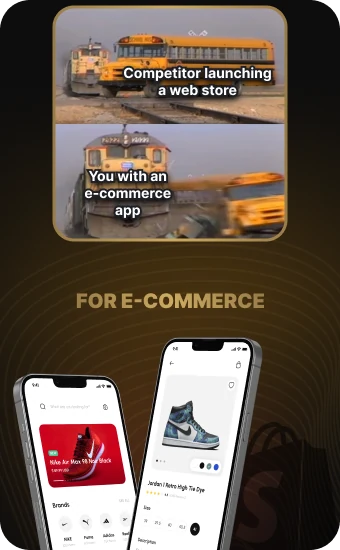
Why Customers Choose to Shop Online
The world is changing, and online shopping is becoming a way of life. Customers choose convenience, speed, and variety. Why spend time going to physical stores when you can order what you need in just a few clicks? Let’s look at what led to this revolution in consumer habits.
The coronavirus changed the rules of the game
The pandemic accelerated the growth of e-commerce. Stores without mobile platforms saw sales decline, while companies with apps adapted much more quickly. Customers began to value services that let them order products and services from home. This gave a major push to the mass development of mobile apps for online stores.
People love convenience
Digital services are a tool that gives customers everything they need. Ordering food, booking services, and arranging deliveries can all be done in minutes. Apps with a product catalog, filters, discount notifications, and loyalty programs are a perfect fit for users who do not like walking through shopping malls and stores.
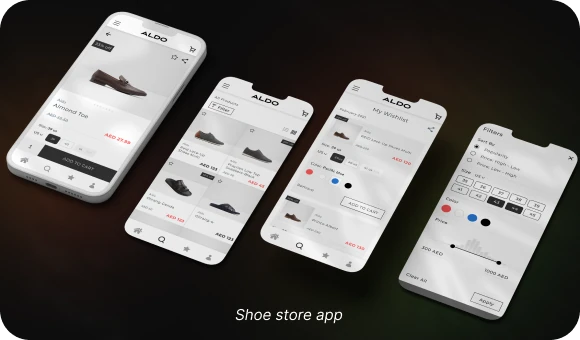
If we talk about the mobile web version of an online store, it is often not suitable for smartphones because of non-responsive design, small buttons, and tiny links. Such websites do not retain users for long.
Apps, on the other hand, make shopping easy and engaging: the user is fully immersed in the process without unnecessary distractions. There are no intrusive ads — only your brand in the spotlight. Simple, convenient, and designed to make shopping enjoyable.
Saving the customer’s time
Time is the most valuable resource. Building an app for your store is a way of telling the customer: “I value your time.” A functional platform, integrated payment and delivery systems, and personalized offers all help build loyalty. Online services win because of speed: users can choose a product, pay, and arrange delivery in just a few minutes.
Loyalty programs are irresistible to shoppers
Loyalty programs built into a mobile platform become a powerful business tool. Customers love personalized offers: discounts, bonuses for repeat purchases, and free delivery.
Adding these features helps your business stand out in the market and increase revenue.
Apps also give you more tools for analyzing user behavior. For example, you can recommend products based on customer preferences. Place these items on the home screen or in the cart section to remind users about potential purchases and increase the chances of checkout completion.
How Building an E-Commerce App Helps a Business
Still not convinced? Then let’s keep going and look at how mobile app development for an online store helps businesses grow.
It attracts a new audience
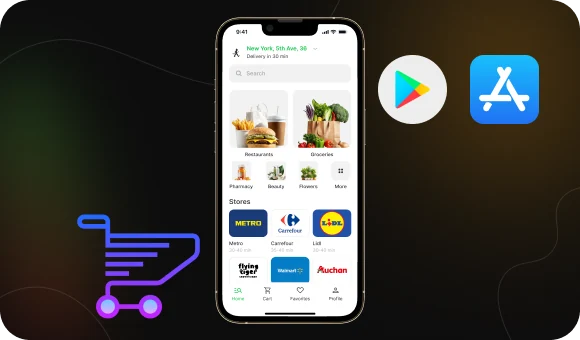
Mobile devices are becoming one of the main channels for online shopping. Users download apps through Google Playand the App Store. If you have an app for both Android and iOS, you can enter these platforms and reach your first customers who enjoy shopping online.
It increases customer retention
Using deep linking, you can direct users to a specific page in the service through SMS, email, an ad banner click, or even a link in Google search results.
It creates opportunities for free marketing
Consumers love showing off their purchases to friends or asking family for advice. In a mobile app, you can add sharing buttons so users can easily post purchases on social media. The result: you gain new customers without additional advertising costs.
It increases sales
Every year, smartphones become more popular for shopping, while desktops account for fewer transactions. Customers are increasingly willing to pay for purchases online. If you want to increase sales, creating a mobile app is a step in the right direction.
E-Commerce App Features
To attract and retain customers, it is important not only to offer quality products, but also to create a convenient and fast shopping process. Let’s move on to the features for buyers and sellers that should be included when developing a mobile app for an online store.
For the buyer
Registration
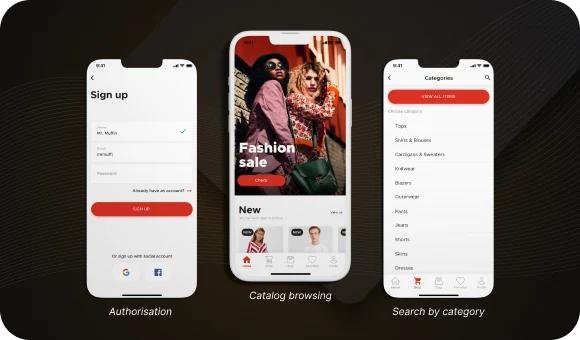
Registration is the first step toward personalized shopping. By creating an account, the customer can save preferences, payment details, and purchase history so that every future purchase becomes easier and faster. Registration also unlocks access to personalized offers and discounts, which is always a nice bonus.
Browsing the product catalog
Each item is presented with bright, detailed images, while the catalog structure helps users quickly find the products they need. Items are sorted by categories, brands, and prices, so users do not get lost in the assortment and can save time.
Convenient filters and category search
If a customer is looking for something specific, filters and search become essential. Add filters by parameters such as color, size, price, and other characteristics, and the system will suggest exactly what the user needs.
Viewing the product page
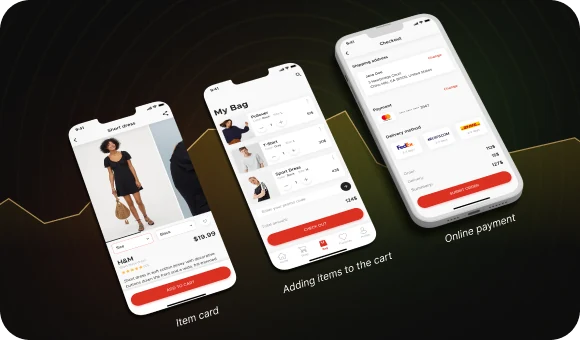
Each product page is like a mini online store on one screen. Here, users can find not only photos, but also detailed descriptions, specifications, reviews from other buyers, and the price. Everything they need to make a confident purchase decision.
Adding products to the cart and completing a purchase
Once a customer finds the right product, they add it to the cart and proceed to checkout. This process should be intuitive, allowing users to easily change quantities, choose options, and add extra items.
Online payment
Include multiple payment methods: bank cards, e-wallets, and mobile payments. The process should be secure, so users do not worry about the safety of their data.
Push notifications
Set up push notifications to inform users about discounts, promotions, or order status changes in real time. This way, customers will not miss attractive offers.
Chat with the seller
It is great if chat support is available 24/7, allowing buyers to quickly get answers about the product range, availability, or delivery conditions.
Ratings and reviews
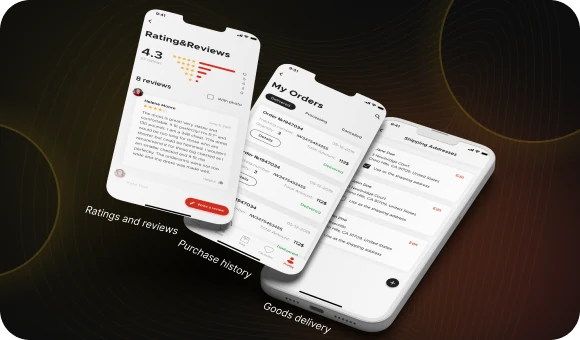
Ratings and reviews help create trust. Buyers can rely on the experience of other people when making their decisions.
Purchase history
Users should be able to quickly return to previously purchased products, reorder them, or track their preferences for future purchases.
Delivery options
Offer several delivery methods, such as standard or express. This gives users a choice and lets them track their parcel in the app while receiving notifications.
For the seller
Creating product listings
The seller should be able to quickly and easily create product cards, add detailed descriptions, images, and specifications. An intuitive interface makes it possible to instantly edit information, update prices, and keep data current.
Chat with the buyer
Chat is instant communication with the customer, always at hand. The seller can quickly answer questions, advise customers on the product range, clarify order details, and handle objections.
Sales control and financial reports
It is important for sales, revenue, and expense reports to be presented in a convenient format, with the ability to filter data by time, category, and region. This helps track business performance and make development decisions.
Inventory and stock management
With up-to-date warehouse and stock information, the seller can quickly update availability, monitor shortages or excess inventory, manage orders, and replenish stock in time. This function helps prevent shortages and interruptions in sales.
Stages of Creating a Successful Online Store App
And now for the most interesting part — the process of building a mobile app for an online store. Below are the main points to consider during development.
Discovery phase
We start with analysis: studying user needs and current online shopping trends. This helps create an app that will be in demand on the market.
Defining the target audience
Understanding your audience is the foundation. Analyze who your buyers are: students, businesspeople, families with children. By clearly defining your target audience, you can make the interface and functionality as convenient and understandable for them as possible.
Competitor app analysis
Looking at what competitors are doing helps you understand what works and what does not. Analyze their strengths and weaknesses to avoid mistakes and offer customers the best possible experience.

Defining functionality and writing the technical specification
Think through what functionality the app should include: one-click ordering, cart, personal account, filters. Describe the features in detail so the development team clearly understands what needs to be built.
UX/UI design
Design is the path the user takes. Make the interface intuitive, stylish, and lightweight so the shopping process becomes a genuine pleasure.
Development
Now the programmers bring all of this to life in code. They integrate payment systems, make the app fast and secure, and ensure it works well on both iOS and Android devices.
Testing and bug fixing
Carefully check every detail, test the service on devices, and fix bugs. The app should run smoothly, and users should feel that everything has been polished.
Release to app stores and promotion
Done. Publish the app in the App Store and Google Play, and launch a bright, active marketing campaign. Now everyone needs to know that a great online store with a convenient app has arrived.

App growth and support
Launch is only the beginning. Update the app and catalog, add new features, and listen to users to keep improving the shopping experience.
Conclusion
A mobile app for an online store is a step into the future and an opportunity for business growth and customer acquisition. With a convenient interface, fast delivery, and personalized offers, your store can become a favorite among users.
Professional development is the key to creating a successful product. Beetrail can become your reliable partner at every stage of the journey.
We create solutions that help businesses grow, adapt to market changes, and become closer to their customers. We provide full-cycle development: from concept to publication and support.
Explore our projects and leave a request through the form below. Together, we will find the best solution for your goals.
Every successful project begins with a first step. Take it with Beetrail.
Why Customers Choose to Shop Online
The world is changing, and online shopping is becoming a way of life. Customers choose convenience, speed, and variety. Why spend time going to physical stores when you can order what you need in just a few clicks? Let’s look at what led to this revolution in consumer habits.
The coronavirus changed the rules of the game
The pandemic accelerated the growth of e-commerce. Stores without mobile platforms saw sales decline, while companies with apps adapted much more quickly. Customers began to value services that let them order products and services from home. This gave a major push to the mass development of mobile apps for online stores.
People love convenience
Digital services are a tool that gives customers everything they need. Ordering food, booking services, and arranging deliveries can all be done in minutes. Apps with a product catalog, filters, discount notifications, and loyalty programs are a perfect fit for users who do not like walking through shopping malls and stores.
If we talk about the mobile web version of an online store, it is often not suitable for smartphones because of non-responsive design, small buttons, and tiny links. Such websites do not retain users for long.
Apps, on the other hand, make shopping easy and engaging: the user is fully immersed in the process without unnecessary distractions. There are no intrusive ads — only your brand in the spotlight. Simple, convenient, and designed to make shopping enjoyable.
Saving the customer’s time
Time is the most valuable resource. Building an app for your store is a way of telling the customer: “I value your time.” A functional platform, integrated payment and delivery systems, and personalized offers all help build loyalty. Online services win because of speed: users can choose a product, pay, and arrange delivery in just a few minutes.
Loyalty programs are irresistible to shoppers
Loyalty programs built into a mobile platform become a powerful business tool. Customers love personalized offers: discounts, bonuses for repeat purchases, and free delivery.
Adding these features helps your business stand out in the market and increase revenue.
Apps also give you more tools for analyzing user behavior. For example, you can recommend products based on customer preferences. Place these items on the home screen or in the cart section to remind users about potential purchases and increase the chances of checkout completion.
How Building an E-Commerce App Helps a Business
Still not convinced? Then let’s keep going and look at how mobile app development for an online store helps businesses grow.
It attracts a new audience
Mobile devices are becoming one of the main channels for online shopping. Users download apps through Google Playand the App Store. If you have an app for both Android and iOS, you can enter these platforms and reach your first customers who enjoy shopping online.
It increases customer retention
Using deep linking, you can direct users to a specific page in the service through SMS, email, an ad banner click, or even a link in Google search results.
It creates opportunities for free marketing
Consumers love showing off their purchases to friends or asking family for advice. In a mobile app, you can add sharing buttons so users can easily post purchases on social media. The result: you gain new customers without additional advertising costs.
It increases sales
Every year, smartphones become more popular for shopping, while desktops account for fewer transactions. Customers are increasingly willing to pay for purchases online. If you want to increase sales, creating a mobile app is a step in the right direction.
E-Commerce App Features
To attract and retain customers, it is important not only to offer quality products, but also to create a convenient and fast shopping process. Let’s move on to the features for buyers and sellers that should be included when developing a mobile app for an online store.
For the buyer
Registration
Registration is the first step toward personalized shopping. By creating an account, the customer can save preferences, payment details, and purchase history so that every future purchase becomes easier and faster. Registration also unlocks access to personalized offers and discounts, which is always a nice bonus.
Browsing the product catalog
Each item is presented with bright, detailed images, while the catalog structure helps users quickly find the products they need. Items are sorted by categories, brands, and prices, so users do not get lost in the assortment and can save time.
Convenient filters and category search
If a customer is looking for something specific, filters and search become essential. Add filters by parameters such as color, size, price, and other characteristics, and the system will suggest exactly what the user needs.
Viewing the product page
Each product page is like a mini online store on one screen. Here, users can find not only photos, but also detailed descriptions, specifications, reviews from other buyers, and the price. Everything they need to make a confident purchase decision.
Adding products to the cart and completing a purchase
Once a customer finds the right product, they add it to the cart and proceed to checkout. This process should be intuitive, allowing users to easily change quantities, choose options, and add extra items.
Online payment
Include multiple payment methods: bank cards, e-wallets, and mobile payments. The process should be secure, so users do not worry about the safety of their data.
Push notifications
Set up push notifications to inform users about discounts, promotions, or order status changes in real time. This way, customers will not miss attractive offers.
Chat with the seller
It is great if chat support is available 24/7, allowing buyers to quickly get answers about the product range, availability, or delivery conditions.
Ratings and reviews
Ratings and reviews help create trust. Buyers can rely on the experience of other people when making their decisions.
Purchase history
Users should be able to quickly return to previously purchased products, reorder them, or track their preferences for future purchases.
Delivery options
Offer several delivery methods, such as standard or express. This gives users a choice and lets them track their parcel in the app while receiving notifications.
For the seller
Creating product listings
The seller should be able to quickly and easily create product cards, add detailed descriptions, images, and specifications. An intuitive interface makes it possible to instantly edit information, update prices, and keep data current.
Chat with the buyer
Chat is instant communication with the customer, always at hand. The seller can quickly answer questions, advise customers on the product range, clarify order details, and handle objections.
Sales control and financial reports
It is important for sales, revenue, and expense reports to be presented in a convenient format, with the ability to filter data by time, category, and region. This helps track business performance and make development decisions.
Inventory and stock management
With up-to-date warehouse and stock information, the seller can quickly update availability, monitor shortages or excess inventory, manage orders, and replenish stock in time. This function helps prevent shortages and interruptions in sales.
Stages of Creating a Successful Online Store App
And now for the most interesting part — the process of building a mobile app for an online store. Below are the main points to consider during development.
Discovery phase
We start with analysis: studying user needs and current online shopping trends. This helps create an app that will be in demand on the market.
Defining the target audience
Understanding your audience is the foundation. Analyze who your buyers are: students, businesspeople, families with children. By clearly defining your target audience, you can make the interface and functionality as convenient and understandable for them as possible.
Competitor app analysis
Looking at what competitors are doing helps you understand what works and what does not. Analyze their strengths and weaknesses to avoid mistakes and offer customers the best possible experience.
Defining functionality and writing the technical specification
Think through what functionality the app should include: one-click ordering, cart, personal account, filters. Describe the features in detail so the development team clearly understands what needs to be built.
UX/UI design
Design is the path the user takes. Make the interface intuitive, stylish, and lightweight so the shopping process becomes a genuine pleasure.
Development
Now the programmers bring all of this to life in code. They integrate payment systems, make the app fast and secure, and ensure it works well on both iOS and Android devices.
Testing and bug fixing
Carefully check every detail, test the service on devices, and fix bugs. The app should run smoothly, and users should feel that everything has been polished.
Release to app stores and promotion
Done. Publish the app in the App Store and Google Play, and launch a bright, active marketing campaign. Now everyone needs to know that a great online store with a convenient app has arrived.
App growth and support
Launch is only the beginning. Update the app and catalog, add new features, and listen to users to keep improving the shopping experience.
Conclusion
A mobile app for an online store is a step into the future and an opportunity for business growth and customer acquisition. With a convenient interface, fast delivery, and personalized offers, your store can become a favorite among users.
Professional development is the key to creating a successful product. Beetrail can become your reliable partner at every stage of the journey.
We create solutions that help businesses grow, adapt to market changes, and become closer to their customers. We provide full-cycle development: from concept to publication and support.
Explore our projects and leave a request through the form below. Together, we will find the best solution for your goals.
Every successful project begins with a first step. Take it with Beetrail.