02.06.2026
Time to read:
9
min
Fitness mobile app development from scratch
Development
Interest in a healthy lifestyle has been becoming more visible from one generation to the next. If sport and nutrition tracking were once mainly for enthusiasts, today they have become a привычная part of life for millions of people, driven by digital technologies and easy access to information.
The COVID-19 pandemic became a turning point for the fitness industry. Closed gyms and restrictions on in-person classes pushed millions of people to look for online tools to stay in shape, while companies began developing those solutions. Video lessons, streaming platforms, and fitness apps stopped being just a temporary substitute and became a full-fledged service or a complement to traditional workouts. Many users moved to a hybrid format, combining gym visits with app-based training at home or outdoors.
Today, a fitness app is a mobile tool for workouts and recovery, available to users 24/7: personalized plans and video lessons, exercise and activity tracking, a nutrition diary, reminders, motivation and community features, and integrations with wearables for more accurate data. That is why fitness app development is becoming a strategic step for companies that want to give users a clear path toward their goals and secure a place in a growing market.

What Is Shaping the Fitness Market Today
The numbers confirm the trend: over the past three years, the global online fitness market has grown by nearly 60%, while in Russia, user spending on fitness apps and related digital services reached around 5 billion rubles in 2024, highlighting rapidly increasing demand for such solutions. This growth is driven by digitalization, the widespread adoption of smartwatches and fitness trackers, and the rise of AI, which makes recommendations more personalized. In this environment, fitness mobile app development has become a way to enter a fast-growing market with a product capable of keeping users engaged.
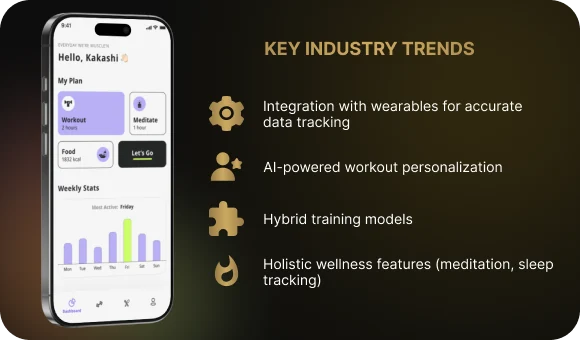
Key trends:
- integration with wearable devices for more accurate data collection;
- AI-powered program personalization and development based on behavioral data;
- hybrid training formats — combining offline sessions with on-demand content in apps;
- expanding functionality beyond fitness: meditation, sleep tracking, and nutrition management.
From Beginners to Wellness Enthusiasts: Who Needs Fitness Apps and Why
The target audience for fitness apps is highly diverse — from people stepping into a gym for the first time to professional trainers and biohackers tracking every aspect of their physical health. Developing these solutions requires a clear understanding of the goals, needs, and expectations of each group.
Beginners
They are taking their first steps with workouts at home or in the gym and are looking for programs with simple exercises, step-by-step video tutorials, and motivation. For this audience, development should focus on an intuitive interface, gamification elements such as badges, challenges, and activity rewards, as well as community support through chats and forums.
Experienced fitness enthusiasts
They need advanced analytics such as distance, speed, and heart rate zones, integration with devices like Garmin or Apple Watch, personalized plans tailored to specific goals, and competitive features. During development, it is important to address their need for precise data and progress comparison tools, as seen in Strava with route segments, interest-based clubs, and global rankings.
Industry professionals
Trainers and fitness clubs use apps for remote sessions, progress analytics, subscription management, and communication with clients. This audience prioritizes service quality, so they need specialized solutions that the development team must take into account. The success of FitStars shows that such services can become полноценной platforms for online coaching.
Health-focused users
They monitor nutrition, sleep, and stress levels and are interested in yoga and meditation. When developing apps for this audience, it is important to include food journals, water trackers, recipes, and other tools for comprehensive wellness management and goal achievement. MyFitnessPal appeals to this segment with its database of 19 million foods and convenient barcode scanner. Solutions that allow users to work out, relax, and track habits all in one place are especially popular.
Fitness app development requires taking the interests of all these segments into account, combining sport, health, and motivation in a single solution.
The Strongest Players in the Online Fitness Industry
Strava. Launched in 2009 as a GPS tracker for cyclists, Strava has grown into a global social network for athletes with 135 million users across 190 countries. From the beginning, the product was built around gamification and competitive elements — its signature feature is route segments and leaderboards, where users can compete for the top spot. Its freemium model, advanced analytics, and live tracking have made it a benchmark for runners and cyclists, and Strava data is even used in urban planning.
Nike Run Club / Nike Training Club. Nike has long moved beyond sportswear: NRC and NTC are used by tens of millions of people. These apps were developed with a focus on integration into the brand ecosystem and on encouraging regular training. During the pandemic, Nike made its premium content free, doubling engagement. Integration with Apple Watch and the wider Nike ecosystem makes these apps a powerful loyalty tool.
MyFitnessPal. Founded in 2005, this app became a global leader in nutrition tracking, with an audience of over 200 million users. Its convenient barcode scanner, macronutrient goals, and integration with other services have made it a must-have for people who monitor their diet.
Fitbit. One of the pioneers of wearable trackers, Fitbit has sold more than 100 million devices. Its app syncs with bands and watches to track steps, sleep, heart rate, and calories. With 38 million active weekly users, it also has a strong position in corporate wellness. Since 2021, it has been part of Google, but the brand remains highly recognizable.
FitStars. A leader in home fitness in Russia and the CIS. Launched in 2017, the service took off during the pandemic by offering Russian-language workouts that required no equipment. Its success was driven by localized content, affordable pricing, and active influencer marketing, while audience retention came from continuously updated courses and trainer support within the app. The project became a strong example of how to build successful products tailored to local market demand.
Features That Make a Fitness App Competitive
Whether the user is a beginner or a pro, they expect an app to provide all the essential functionality for training and progress tracking right away. There is a core set of features without which the product will not be viable on the market, and there are advanced capabilities that increase the service’s value and help it stand out from competitors. When planning a project, it is important to account for all of this. This approach helps businesses increase user loyalty and extend engagement time within the service.
Core features
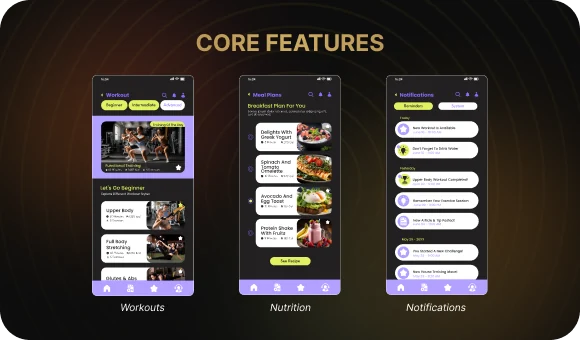
Registration and profile: entering personal data such as height, weight, and goals to personalize recommendations.
Workouts: training plans, video and audio instructions, and workout tracking.
Nutrition: food diary, calorie and macronutrient calculator, and water intake tracking.
Notifications: workout reminders and motivational messages.
Wearable integration: Apple Watch, Fitbit, Garmin, and GPS tracking.
Advanced features
Artificial intelligence: automatic plan generation, progress analysis, and load adjustment.
Social features: chats, clubs, challenges, and social media sharing.
Gamification: badges, levels, and leaderboards.
Educational content: trainer tips, articles, and exercise collections.
AR/VR modules: motion visualization and exercise technique guidance in augmented reality, allowing users to safely learn proper form even at home.
Building custom fitness mobile apps requires thoughtful design, easy navigation, and strong personal data protection, including GDPR compliance, so that every feature aligns with real user needs.
Fitness App Development: Step by Step
For a fitness app to become convenient and in demand, development goes through several stages. Each step matters — from the initial idea to post-launch updates.
1. Research and planning
First, the team identifies what future users actually need: they conduct surveys, study reviews of similar apps, and analyze competitors. Based on this, they create screen prototypes, or wireframes, and define the minimum feature set needed to enter the market as an MVP — a minimum viable product. This analysis makes it possible to account for audience needs and expectations in advance and lay the groundwork for a successful project.
2. Design
Designers create the app’s look and interaction logic, or UI/UX: they choose colors, fonts, and icons, and make navigation simple and intuitive. The interface should look good across different devices — from smartphones to tablets and web versions — while allowing users to quickly find the features they need and save time.
3. Development
At this stage, the design turns into a working application. Frontend developers are responsible for everything users see and interact with: the app’s appearance, buttons, menus, and animations. Backend developers handle the internal logic — processing data, storing it on the server, and connecting the app to other services. This is also the stage where key features are added: workout and nutrition tracking, integrations with wearables and payment systems, and AI algorithms for personalized recommendations.

4. Testing
Before launch, the app is tested across different devices and under different conditions. Functional testing ensures that every section works as intended, load testing verifies that the app can handle a high number of users, and cross-platform testing checks that the interface displays correctly on iOS, Android, and the web. It also helps identify areas for platform-specific improvements where needed.
5. Launch and support
The app is published in the App Store and Google Play, and if needed, a web version is released as well. After launch, the team continues supporting and growing the project: collecting feedback, fixing bugs, adding new features, and updating content such as workouts, articles, and improved AI algorithms.
This approach makes it possible to build products that grow together with their audience and remain useful for years. That is exactly how specialized fitness mobile apps are developed — with attention to detail at every stage.
How Fitness Apps Make Money and How They Are Promoted
For a fitness app to be not only useful but also profitable, it is important to think through how the company will monetize it, as well as how it will attract and retain users.
Popular monetization models:
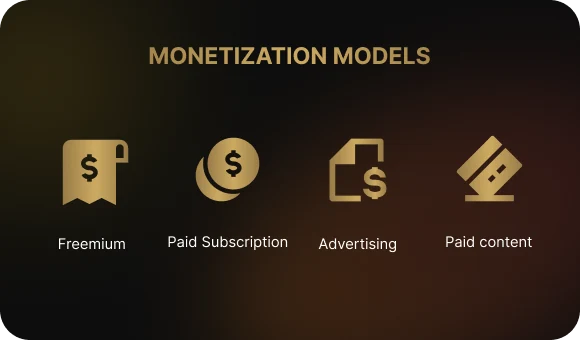
Freemium — core features are free, while a premium subscription unlocks advanced functionality such as ad-free use, exclusive plans, and additional metrics.
Subscription — monthly or annual payment, often with a free trial period. The average price is around $5–10 per month.
Advertising — built-in but non-intrusive ads, for example from sports brands or nutrition companies.
Paid content — individual courses, workout plans, or trainer consultations that users can purchase within the app.
Marketing and promotion:
SEO — optimizing the website and content for search queries such as “fitness app,” as well as articles about physical health, nutrition, and workouts.
Social media — Instagram, TikTok, and YouTube for posting workout videos, challenges, and influencer collaborations.
User retention — push notifications with reminders, loyalty programs, and subscription discounts or offers from partner brands.
For example, Strava uses a freemium model with a subscription tier, while Nike Run Club focuses on free branded content, strengthening user loyalty through the Nike ecosystem.
Conclusion
The fitness app market is growing, competition is becoming stronger, and users expect more convenience and value from digital services. To stand out, it is not enough to just have an idea — you need to execute it properly, from research and design to launch and promotion. We know how to turn a concept into a product that keeps users engaged, motivates them to train, and generates profit.
If you want to build a fitness app that will succeed in the market and align with your business goals, start with a free consultation with our experts. Together, we will define the right strategy and feature set to help your app become a hit.
What Is Shaping the Fitness Market Today
The numbers confirm the trend: over the past three years, the global online fitness market has grown by nearly 60%, while in Russia, user spending on fitness apps and related digital services reached around 5 billion rubles in 2024, highlighting rapidly increasing demand for such solutions. This growth is driven by digitalization, the widespread adoption of smartwatches and fitness trackers, and the rise of AI, which makes recommendations more personalized. In this environment, fitness mobile app development has become a way to enter a fast-growing market with a product capable of keeping users engaged.
Key trends:
- integration with wearable devices for more accurate data collection;
- AI-powered program personalization and development based on behavioral data;
- hybrid training formats — combining offline sessions with on-demand content in apps;
- expanding functionality beyond fitness: meditation, sleep tracking, and nutrition management.
From Beginners to Wellness Enthusiasts: Who Needs Fitness Apps and Why
The target audience for fitness apps is highly diverse — from people stepping into a gym for the first time to professional trainers and biohackers tracking every aspect of their physical health. Developing these solutions requires a clear understanding of the goals, needs, and expectations of each group.
Beginners
They are taking their first steps with workouts at home or in the gym and are looking for programs with simple exercises, step-by-step video tutorials, and motivation. For this audience, development should focus on an intuitive interface, gamification elements such as badges, challenges, and activity rewards, as well as community support through chats and forums.
Experienced fitness enthusiasts
They need advanced analytics such as distance, speed, and heart rate zones, integration with devices like Garmin or Apple Watch, personalized plans tailored to specific goals, and competitive features. During development, it is important to address their need for precise data and progress comparison tools, as seen in Strava with route segments, interest-based clubs, and global rankings.
Industry professionals
Trainers and fitness clubs use apps for remote sessions, progress analytics, subscription management, and communication with clients. This audience prioritizes service quality, so they need specialized solutions that the development team must take into account. The success of FitStars shows that such services can become полноценной platforms for online coaching.
Health-focused users
They monitor nutrition, sleep, and stress levels and are interested in yoga and meditation. When developing apps for this audience, it is important to include food journals, water trackers, recipes, and other tools for comprehensive wellness management and goal achievement. MyFitnessPal appeals to this segment with its database of 19 million foods and convenient barcode scanner. Solutions that allow users to work out, relax, and track habits all in one place are especially popular.
Fitness app development requires taking the interests of all these segments into account, combining sport, health, and motivation in a single solution.
The Strongest Players in the Online Fitness Industry
Strava. Launched in 2009 as a GPS tracker for cyclists, Strava has grown into a global social network for athletes with 135 million users across 190 countries. From the beginning, the product was built around gamification and competitive elements — its signature feature is route segments and leaderboards, where users can compete for the top spot. Its freemium model, advanced analytics, and live tracking have made it a benchmark for runners and cyclists, and Strava data is even used in urban planning.
Nike Run Club / Nike Training Club. Nike has long moved beyond sportswear: NRC and NTC are used by tens of millions of people. These apps were developed with a focus on integration into the brand ecosystem and on encouraging regular training. During the pandemic, Nike made its premium content free, doubling engagement. Integration with Apple Watch and the wider Nike ecosystem makes these apps a powerful loyalty tool.
MyFitnessPal. Founded in 2005, this app became a global leader in nutrition tracking, with an audience of over 200 million users. Its convenient barcode scanner, macronutrient goals, and integration with other services have made it a must-have for people who monitor their diet.
Fitbit. One of the pioneers of wearable trackers, Fitbit has sold more than 100 million devices. Its app syncs with bands and watches to track steps, sleep, heart rate, and calories. With 38 million active weekly users, it also has a strong position in corporate wellness. Since 2021, it has been part of Google, but the brand remains highly recognizable.
FitStars. A leader in home fitness in Russia and the CIS. Launched in 2017, the service took off during the pandemic by offering Russian-language workouts that required no equipment. Its success was driven by localized content, affordable pricing, and active influencer marketing, while audience retention came from continuously updated courses and trainer support within the app. The project became a strong example of how to build successful products tailored to local market demand.
Features That Make a Fitness App Competitive
Whether the user is a beginner or a pro, they expect an app to provide all the essential functionality for training and progress tracking right away. There is a core set of features without which the product will not be viable on the market, and there are advanced capabilities that increase the service’s value and help it stand out from competitors. When planning a project, it is important to account for all of this. This approach helps businesses increase user loyalty and extend engagement time within the service.
Core features
Registration and profile: entering personal data such as height, weight, and goals to personalize recommendations.
Workouts: training plans, video and audio instructions, and workout tracking.
Nutrition: food diary, calorie and macronutrient calculator, and water intake tracking.
Notifications: workout reminders and motivational messages.
Wearable integration: Apple Watch, Fitbit, Garmin, and GPS tracking.
Advanced features
Artificial intelligence: automatic plan generation, progress analysis, and load adjustment.
Social features: chats, clubs, challenges, and social media sharing.
Gamification: badges, levels, and leaderboards.
Educational content: trainer tips, articles, and exercise collections.
AR/VR modules: motion visualization and exercise technique guidance in augmented reality, allowing users to safely learn proper form even at home.
Building custom fitness mobile apps requires thoughtful design, easy navigation, and strong personal data protection, including GDPR compliance, so that every feature aligns with real user needs.
Fitness App Development: Step by Step
For a fitness app to become convenient and in demand, development goes through several stages. Each step matters — from the initial idea to post-launch updates.
1. Research and planning
First, the team identifies what future users actually need: they conduct surveys, study reviews of similar apps, and analyze competitors. Based on this, they create screen prototypes, or wireframes, and define the minimum feature set needed to enter the market as an MVP — a minimum viable product. This analysis makes it possible to account for audience needs and expectations in advance and lay the groundwork for a successful project.
2. Design
Designers create the app’s look and interaction logic, or UI/UX: they choose colors, fonts, and icons, and make navigation simple and intuitive. The interface should look good across different devices — from smartphones to tablets and web versions — while allowing users to quickly find the features they need and save time.
3. Development
At this stage, the design turns into a working application. Frontend developers are responsible for everything users see and interact with: the app’s appearance, buttons, menus, and animations. Backend developers handle the internal logic — processing data, storing it on the server, and connecting the app to other services. This is also the stage where key features are added: workout and nutrition tracking, integrations with wearables and payment systems, and AI algorithms for personalized recommendations.
4. Testing
Before launch, the app is tested across different devices and under different conditions. Functional testing ensures that every section works as intended, load testing verifies that the app can handle a high number of users, and cross-platform testing checks that the interface displays correctly on iOS, Android, and the web. It also helps identify areas for platform-specific improvements where needed.
5. Launch and support
The app is published in the App Store and Google Play, and if needed, a web version is released as well. After launch, the team continues supporting and growing the project: collecting feedback, fixing bugs, adding new features, and updating content such as workouts, articles, and improved AI algorithms.
This approach makes it possible to build products that grow together with their audience and remain useful for years. That is exactly how specialized fitness mobile apps are developed — with attention to detail at every stage.
How Fitness Apps Make Money and How They Are Promoted
For a fitness app to be not only useful but also profitable, it is important to think through how the company will monetize it, as well as how it will attract and retain users.
Popular monetization models:
Freemium — core features are free, while a premium subscription unlocks advanced functionality such as ad-free use, exclusive plans, and additional metrics.
Subscription — monthly or annual payment, often with a free trial period. The average price is around $5–10 per month.
Advertising — built-in but non-intrusive ads, for example from sports brands or nutrition companies.
Paid content — individual courses, workout plans, or trainer consultations that users can purchase within the app.
Marketing and promotion:
SEO — optimizing the website and content for search queries such as “fitness app,” as well as articles about physical health, nutrition, and workouts.
Social media — Instagram, TikTok, and YouTube for posting workout videos, challenges, and influencer collaborations.
User retention — push notifications with reminders, loyalty programs, and subscription discounts or offers from partner brands.
For example, Strava uses a freemium model with a subscription tier, while Nike Run Club focuses on free branded content, strengthening user loyalty through the Nike ecosystem.
Conclusion
The fitness app market is growing, competition is becoming stronger, and users expect more convenience and value from digital services. To stand out, it is not enough to just have an idea — you need to execute it properly, from research and design to launch and promotion. We know how to turn a concept into a product that keeps users engaged, motivates them to train, and generates profit.
If you want to build a fitness app that will succeed in the market and align with your business goals, start with a free consultation with our experts. Together, we will define the right strategy and feature set to help your app become a hit.