Medical information system: how to choose a ready-made solution or develop your own?
Medical information system: How to choose a ready-made solution or develop your own?
When a clinic does not have a unified system, the work quickly becomes more complicated. Doctors and administrators keep records in paper journals and spreadsheets, patient data and lab results are stored in different places, and some information is lost. It is becoming more and more difficult to control doctors' workload, money and quality of service, especially as private clinics grow.
To restore order in these processes, clinics are introducing medical information systems — MIS. Today, there are already dozens of MIS solutions on the market: cloud and boxed products, subscription systems, and custom development options. Formally, there is a lot of choice, but this is why it is difficult for the manager to understand what is right for the clinic.
A medical information system can be standard or designed for specific clinic processes. Below we will analyze these options, compare them in simple words and show which path is suitable for different tasks and business sizes.
What is MIS and why does the clinic need it
What is MIS and why does the clinic need it
MIS is a medical information system, essentially a clinic's operating system. It contains all the daily work: patient records and doctors' schedules, electronic records, appointments, test results, payments and reports. Some services also keep track of inventory, services, and payroll. Instead of dozens of magazines and tables, the medical center operates in one place.
Such a platform reduces routine for staff and reduces errors. Doctors find patient data faster, administrators see the current record, and management gets a clear picture of doctors' workload and money. This means a more comfortable service for the patient: online appointments, appointment reminders, access to their medical information.

At the same time, any programs for doctors must take into account the requirements for the protection of personal data and work correctly with government systems. These restrictions affect the architecture and solution choice, so it is important to consider them even at the stage of implementing MIS.
Three MIS options for the clinic and how they differ
Three MIS options for the clinic and how they differ
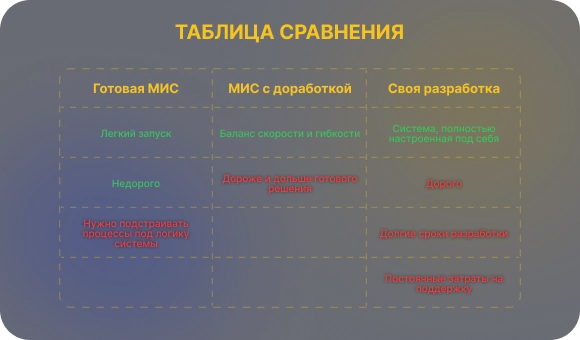
In practice, medical centers have three options for working through MIS. A medical information system can be a ready-made product, a modified solution, or its own development. Each approach has a different impact on clinic management, data accounting, electronic document management and the ability to integrate with laboratories, cash desks and external services. The chosen program determines the launch speed, the flexibility of processes, and how comfortable it is for staff to work with the service and get the information they need.
1. Ready-made MIS (“out of the box”)
The clinic buys or rents a ready-made product, most often by subscription. This system has a basic set of features: patient records, doctors' schedules, electronic maps, finances, and reports.
Pros: easy to start, relatively inexpensive.
Cons: the medical center has to adjust its processes to the logic of the system.
2. Ready-made MIS with customization
It is based on a ready-made program for a polyclinic, which is supplemented with the necessary functions and capabilities. This can be a patient's personal account, a mobile application, non-standard analytics, or additional integrations.
Pros: balance between launch speed and flexibility.
Cons: the cost and terms are higher than that of the ready-made solution.
3. Fully developed
The system is created from scratch for the processes of a particular clinic or network. This approach gives you complete freedom, but requires serious resources.
Pros: the system fully complies with the business logic of the medical center.
Cons: high cost, long development times and constant support costs.
Regardless of the MIS option chosen, it is important for the clinic to evaluate not only the functionality, but also how the system supports daily work. Process management, data accounting, electronic document management and integration with external services directly affect business sustainability. The more accurately the program meets the clinic's objectives, the more opportunities it provides for growth and control.
When is your own MIS development justified
When is your own MIS development justified
Not all private clinics need their own development or major refinement of MIS. In most cases, ready-made solutions cover basic processes and make it possible to build stable operation at no extra cost. Difficulties arise when a medical center grows, complicates services, and faces the limitations of a typical process and data management system. At this point, integration with the laboratory, external services and internal modules begins to play a role, and MIS turns from a simple program into the main management element of the clinic.
Self-development or detailed refinement of an MIS may be justified if:
- the clinic is turning into a network with several branches in different cities;
- the patient has a difficult route: transfers between departments, observation programs, doctors;
- non-standard loyalty schemes, subscriptions or complex pricing are used;
- we need a strong focus on analytics, reports for investors or non-standard BI tools.

At the same time, it is important to understand that your own MIS is not a way to save money. This is a separate product that requires constant investments: in development, support, updates and security. This path makes sense only if there is a clear growth strategy and a willingness to develop the system, and not count on immediate results.
5 steps to choose: your own medical software or a ready-made one
5 steps to choose: your own medical software or a ready-made one
Electronic medical systems can be implemented as a ready-made solution or developed as your own medical software. In the second case, the clinic undertakes not only the development, but also ongoing support, the development of MIS, integration with external services and the associated risks for business operations. In order not to make an emotional decision and not to overpay for the wrong option, it is important to first soberly assess your tasks, processes and resources — step by step and consistently.
1. Define 3-5 main tasks.
Start not with technology, but with the problems that hinder the work of the medical center at this stage. Consider where time, money, or patients are being lost, and which processes are most affected.
Example: the clinic has constant queues for administrators and confusion with appointments. In this case, the priority is a clear record and schedule, rather than complex analytics or custom reports.
2. Divide requirements into mandatory and desirable requirements.
Clearly separate what the system doesn't make sense without from features you can add later. This greatly simplifies the choice and reduces the risk of overpayment.
Example: dentistry requires an electronic patient record and treatment history. A personal account or mobile application for patients can be implemented at the next stage.
3. Check out some ready-made solutions.
Even if you are leaning towards self-development, ready-made systems are worth exploring. They help you understand the market standard and see what tasks are already being solved out of the box.
Example: The doctor is comfortable filling out the card and does it in a few minutes, but the administrator is confused about the record. This is a signal that the system is not suitable for all roles in the clinic.
4. Find “holes” in ready-made solutions.
Record what features or logic the processes lack. It is important to distinguish minor inconveniences from significant restrictions.
Example: the system does not support complex patient monitoring programs. If a medical center makes money on such programs, this restriction becomes critical.
5. Calculate not only the purchase, but also the implementation.
The cost of a system is not just a license or development. It is necessary to take into account staff training, data transfer, possible downtime and post-launch support.An example: In dentistry, the system itself may be inexpensive, but training doctors and administrators, as well as wasting time on implementation, are more expensive than a license.

This approach allows us to soberly assess what role MIS should play in the clinic. This is not just a recording program, but a system that supports the daily work of doctors and administrators and the management of processes in a private clinic. It is important for dentistry, a multidisciplinary center or network to understand in advance how the information circuit will be built, what integrations will be required with the laboratory and external services, and who will be responsible for developing the platform. This helps you choose a solution that works for your business, rather than creating new restrictions.
Honest conclusion: how to choose MIS at no extra cost
There is no single right solution. The choice of MIS depends on the size of the clinic, the rate of growth, the complexity of the processes and the budget. What works well in a small private clinic may not be suitable for a network of several medical centers, and vice versa.
A smart start is not to start with the idea of “I want my own MIS”, but with an honest list of business problems and goals. Medical programs for medical institutions already cover most of the typical clinic tasks, and this should be checked first. Only if ready-made solutions really don't fit the processes does it make sense to move on to discussing custom development.
If you want specialists with practical experience in implementing and developing MIS to help you choose an approach, contact us at Beetrail. We will analyze your clinic's tasks, assess what can be solved with ready-made solutions, and where you need refinement or self-development. This approach allows you to make an informed decision and not return to the issue of replacing the system in a year.