
Updated November 2026
What this guide covers
If you already run a TMS, a WMS, or your own delivery platform, AI in logistics should start with one reliable order status. Then come the documents your team retypes, then customer updates, and only then route optimization. This guide puts the usual use cases in order.
In short:
- Give every order one current status in one place before you add any model.
- Automate the paperwork people copy by hand: PDF orders, freight invoices, proofs of delivery.
- Answer “where is my order” from the status you now trust.
- Optimize routes last, when stop data is clean enough to plan on.
- Check before each step that the previous one holds.
What AI in logistics does today
In logistics, AI reads, predicts, and decides on top of data your systems already hold. It plans loads and routes, tracks shipments, pulls orders and invoices out of documents, and answers status questions. The model is new. The data it works on is the data you have today.
Planning and tracking are where logistics providers use it most. In a BCG survey from January 2026, 64% of logistics providers used AI in transport planning, and about 50% in tracking and visibility.
Where AI works in logistics
-
Planning loads and routes
-
Tracking shipments
-
Reading orders and invoices
-
Answering status questions
AI agents are the next layer. They take a task end to end instead of answering one question. Gartner expects the share of companies with agent features in their supply chain software to grow from 5% in 2025 to 60% by 2030. An agent still needs the same thing a simple model does: a record it can trust.
Why most companies stall: pilots that never reach daily work
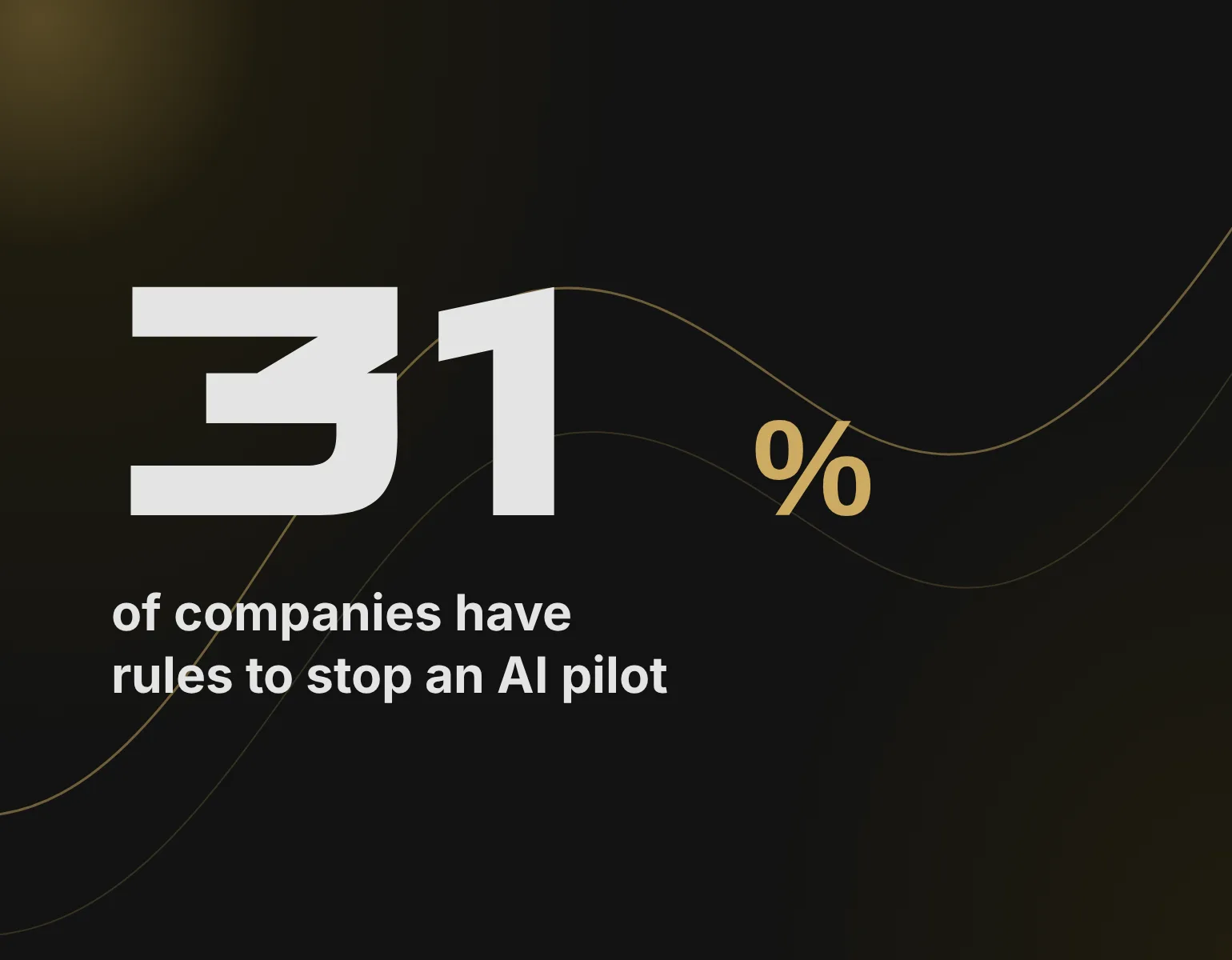
Many logistics companies have piloted AI, yet among carriers and 3PLs only about one in ten has it inside core operations. The gap is usually the work of connecting AI to the systems people use every day: the TMS, the warehouse system, the inbox, and the spreadsheets that fill the gaps between them. A pilot can skip that work for a month. Daily operations can’t.
The BCG numbers show where it breaks. About 40% of carriers and 3PLs have moved AI beyond pilots, yet only about one in ten has embedded it at scale. Shippers look the same: almost 70% are still exploring or piloting, and 7% can point to measurable results.
AI in logistics, January 2026
-
40 %
providers beyond pilots
-
1 in 10
providers at scale
-
7 %
shippers with measurable results
BCG, March 2026 (survey January 2026)
Smaller companies feel it more. In the BCG survey of the AI in logistics industry, high upfront cost is a hurdle for 44% of small firms and 25% of large ones.
A pilot stalls for a simple reason. It runs next to the operation, on an export someone prepared by hand. The day it has to read live orders, it finds three versions of each one.
Why routes aren’t first, even though everyone wants them
Route scheduling tops the wish list in ORTEC’s survey on agentic AI. It also depends heavily on clean, current stop and order data. In a company where order status lives in several tools, it fails before it starts.
The demand is real. In an ORTEC survey of more than 2,000 North American logistics executives, published in January 2026, 35% named first- and final-mile route scheduling as the top target for agentic AI. The same survey found the number-one frustration: the high cost of integrating with existing systems, at 32%.
Those two answers belong together. A route plan needs to know which orders are ready, where each stop is, what time window the customer agreed to, and what changed an hour ago. If the TMS says one thing, the dispatcher’s spreadsheet another, and the driver’s chat a third, the model plans on the wrong one.
A common piece of advice says routing is a quick win. It can be, once the data underneath is there. Before that, every planned route becomes a manual correction, and the tool loses the team’s trust.
When we built a delivery platform, the work started from the same pain: split tools caused delays, errors, lost orders, and extra load on support. The fix was one system where the customer, the courier, the store, the restaurant, and the admin all work. Any AI in logistics and supply chain project needs that kind of foundation first.
Step 1. Put one order status in one place
The first step involves no model at all. You need one place where every order has one current status, and where the TMS, dispatch, drivers, and support all read and write it.
Data quality and integration with older systems are the top barriers to AI adoption in logistics, according to the 2027 Third-Party Logistics Study by NTT DATA, Penske, and CSCMP.
Start with one question: where does the status of one order live today? Often it is some mix of these:
- the TMS or your own platform;
- a dispatch tool;
- a dispatcher’s spreadsheet;
- email threads with shippers;
- a carrier portal.
AI can’t fix a status you have five versions of.
Pick one of them as the record and connect the rest to it, by API where you can and by file or inbox where you can’t. This step is ready when someone in support can answer “where is this order” without opening a second tool.
Step 2. Automate the paperwork your team retypes
The second step is the documents people copy by hand: orders from PDFs and emails, freight invoices, proofs of delivery. The work is boring and easy to measure, and it lands straight in the status you just cleaned up.
This is also the safest answer to how to integrate AI in logistics without touching live operations. A model reads the document, fills the fields, and a person confirms. Nothing moves a truck yet.
Invoices are a good place to look. In an nShift survey of more than 120 companies, about three in four said they still check freight invoices manually or not at all. Order entry is the other big one: TTNews and FleetOwner describe small fleets where a large part of the day goes to retyping orders into the TMS.
Measure two things before and after: minutes per document and the share of documents a person had to correct. If the second number drops, the step holds.
Keep a person in the loop longer than feels necessary. The model will be right on clean, typical documents and wrong on the odd ones: a handwritten note on a delivery proof, an invoice with a surcharge nobody expected, an order that mixes two addresses. Those are exactly the cases your team already knows how to handle, and the review queue is where your team sees which ones they are.
Step 3. Answer “where is my order” from the status you trust
Once status lives in one place, customer and partner updates come next. You can take your TMS vendor’s new tracking AI or build on your own status layer. The choice depends on where your status really lives.
Visibility is already a priority: almost 60% of shippers in the BCG survey focus their AI work there. In 2026, Tai TMS and Shipwell both released AI for tracking.
Vendor’s AI
Inside your TMS
- Sees TMS orders only
- Vendor owns the feature
- Can be faster to start
Your status layer
Over all your tools
- Sees every order
- You own the logic
- Covers email and your app
If every order passes through the TMS, the vendor’s feature can be the faster path. If half your orders arrive by email or through your own app, the vendor sees only half. Then an assistant on your own status layer answers for all of them.
This step holds when status calls and emails drop.
Step 4. Now optimize routes
Route optimization comes last, even though it pays well. Planning and routing deliver the strongest reported ROI in the 2027 Third-Party Logistics Study. In our view, that return shows up only when the plan reads clean data: which orders are ready, where each stop is, and what changed an hour ago. Steps 1 to 3 give it that data.
Even the best-known example took years. UPS reported in 2015 that its ORION routing system cut 6–8 miles per route. It got there after 10 years of development and a rollout that started in 2012. The gain came from small numbers on every route, repeated daily.
Routes are only as good as the stop data under them.
For a smaller fleet, the first version is narrower. Start with one depot or one region. Compare planned and actual stops for a few weeks before the plan goes to drivers.
Recap: the order in four steps
For a company that already runs its own software, AI in logistics goes in this order: one status, the paperwork that feeds it, customer updates, and then routes.
-
One status
One record per order
-
Paperwork
PDFs, invoices, proofs
-
Updates
“Where is my order”
-
Routes
On clean stop data
What each step needs, and how you know it holds:
| Step | What it needs | Ready for the next step when |
|---|---|---|
| One status | One system chosen as the record for orders | Support answers a status question without a second tool |
| Paperwork | Sample documents and a person to review | Fewer documents need manual correction |
| Customer updates | Status that changes as the order moves | Status calls and emails drop |
| Routes | Clean stop addresses, time windows, and history | Planned and actual stops match for several weeks |
The table is also a quick test of where you are today. If you are still on the first row, that is a normal place to start.
What to read next:
- How to implement AI in business: where to start
- AI readiness assessment: what to prepare first
- AI proof of concept: how to scope one
If you want a second look at one process, our AI automation team runs a free short review.
FAQ
Do I need to replace my TMS to use AI?
Usually no. AI connects to the TMS through its API, through file exports, or through the inbox where orders arrive. The work goes into connecting the system you have.
What can AI agents do in logistics today?
They can take a narrow task end to end: read an order email, create the shipment, and ask a person to confirm. Gartner warns that vendors promising fully autonomous supply chain planning before 2027 overstate what is possible. ORTEC found that 42% of logistics leaders are not exploring agents at all yet.
Will AI replace entry-level logistics jobs?
Supply chain leaders expect fewer entry-level hires. In a Gartner survey of supply chain leaders, 55% expect agentic AI to reduce entry-level hiring, and 86% say it will require new processes. We expect retyping and status calls to shrink first, while checking exceptions and talking to customers stay with people.
How long until we see results?
A pilot on one process, such as invoice checks or order entry, runs 4–6 weeks on your own data. Route optimization across a whole fleet takes longer, because it waits on clean data from the steps before it.
- What this guide covers
- What AI in logistics does today
- Why most companies stall: pilots that never reach daily work
- Why routes aren’t first, even though everyone wants them
- Step 1. Put one order status in one place
- Step 2. Automate the paperwork your team retypes
- Step 3. Answer “where is my order” from the status you trust
- Step 4. Now optimize routes
- Recap: the order in four steps
- FAQ